SP_PM4D_070
© Marcelle

MARSEILLE - Marcelle EMI has transformed a media literacy experiment into a digital resource that is now firmly established in secondary schools. After an initial wave of adoption in the first half of 2026, the start of the new school year in September marked a sharp acceleration: 174 secondary schools in the Provence-Alpes-Côte d'Azur region have now subscribed, and more than 70,000 pupils and teachers have individually activated the resource. 

The platform combines articles, audio and video content, social media formats, educational resources for teachers and classroom sessions with journalists.

The project is now entering a second phase, with geographical expansion, a growing number of classroom sessions and the development of new digital formats designed to reach young people through the channels they use every day to access information.

Project Activities

PM4D funding enabled Marcelle to create Marcelle EMI and obtain official approval for the platform, which is integrated into GAR, the French Ministry of Education's secure digital environment. It offers a selection of Marcelle's journalistic reports alongside shorter formats — audio, video and carousels — designed as gateways to the full articles. A dedicated "Teachers' Room" also provides educators with resources to help them understand how journalism works behind the scenes and to use the topics in the classroom. This educational component was developed with Reporters d'Espoirs and CLEMI.

Following the launch of the platform at the end of 2025, an initial wave of success followed in the first half of 2026. It confirmed both that the resource was meeting a need within schools and that young people were willing to engage with more in-depth journalism when it was introduced through formats aligned with their digital habits.

The start of the new school year in September 2026 marked a new stage, with a sharp increase in individual activations. In Provence-Alpes-Côte d'Azur, 174 secondary schools have now subscribed to Marcelle EMI, and more than 70,000 pupils and teachers have individually activated the resource. This momentum shows that Marcelle EMI is no longer simply an experiment but is becoming part of everyday teaching practice.

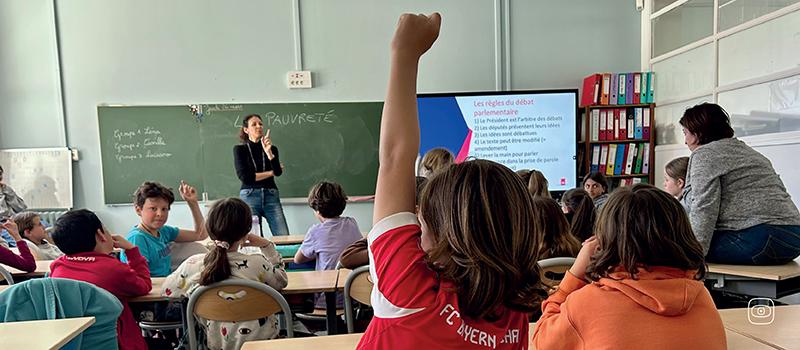
The programme is also expanding inside classrooms. Journalists are increasingly working directly with pupils, helping them understand in practical terms how news is produced: choosing a subject, finding and checking sources, comparing different viewpoints and distinguishing between reporting, analysis and opinion.

Marcelle also supports educational projects developed with schools and associations, some of which lead to genuine journalistic work published by the outlet. One example is a project carried out over almost a year by pupils at Lycée Thiers on supervised drug consumption rooms. Field visits, interviews with experts and analysis of scientific studies led to a presentation at the French National Assembly, followed by a public debate in Marseille.

Finally, Marcelle is preparing for a new technological stage. An artificial intelligence tool integrated into the editorial workflow will make it possible to adapt journalistic content more efficiently for social media, further strengthening the outlet's ability to reach young people on the platforms where they now consume much of their information. AI will be used to adapt and distribute content; the original journalism, reporting and editorial validation will remain the work of journalists.

What is the impact?

Marcelle EMI was designed with particular attention to schools in disadvantaged and priority neighbourhoods, especially in Marseille. The starting point was straightforward: in some areas, young people have little direct contact with the press and get most of their news through social media. The project brings a journalistic resource directly into their digital school environment, without requiring them to seek out a news outlet themselves.

This approach was at the heart of the original project: using schools as places where young people can access verified information and develop critical thinking skills, particularly in neighbourhoods where access to local journalism is limited. The strong growth in individual activations in 2026 now provides a concrete indication that the resource is being adopted.

The impact, however, goes beyond access to articles. The combination of the digital platform, resources for teachers, formats adapted to young people's digital habits and the growing presence of journalists in classrooms is helping to re-establish direct contact between a generation increasingly distant from traditional news media and the professionals who produce journalism.

The first change is quantitative. Following an initial increase in the first half of 2026, the start of the new school year in September brought a dramatic acceleration: more than 70,000 pupils and teachers in the Provence-Alpes-Côte d'Azur region have now individually activated the resource.

The second change is editorial. The project has led Marcelle to make lasting changes to the way it produces and distributes journalism. Social media platforms are no longer seen simply as tools for driving readers to the website, but as spaces for journalism in their own right. This shift was already measurable at the end of the project: the final report recorded increases of 16% on Instagram, 12% on LinkedIn and 4% on Facebook, together with an 18% increase in overall visits to the outlet.

Finally, the project is gradually creating a direct, real-world relationship between the outlet and schools. Journalists are increasingly working in classrooms, while Marcelle supports educational initiatives that can themselves become subjects for journalistic coverage. Young people are therefore no longer simply recipients of information: they discover how journalism is produced, take part in the reporting process and test their own perceptions against verified facts.

Project Picture

Photos by Marcelle

Supported
€21,000 allocated on 04/04/2025
ID:
PM4D/2025/070

Publication

WEBSITE

SOCIAL MEDIA

COUNTRY

  • France

Media

Need resources for your own investigative story?

Journalismfund Europe's flexible grants programmes enable journalists to produce relevant public interest stories with a European mind-set from international, national, and regional perspectives.

Support independent cross-border investigative journalism

We rely on your support to continue the work that we do. Make a gift of any amount today.