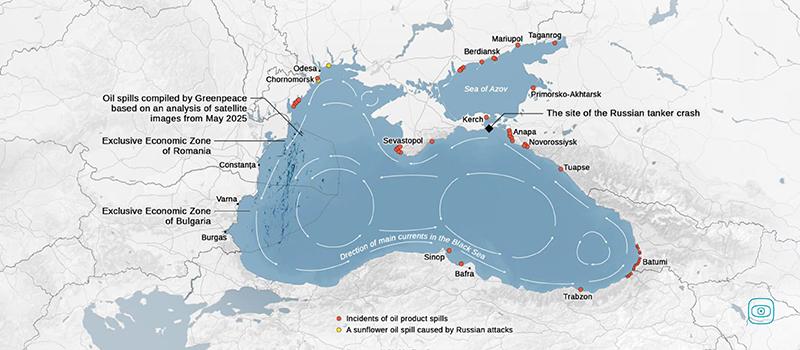
In December 2024, two Russian tankers carrying Rosneft fuel oil sank in the Kerch Strait, spilling thousands of metric tons of fuel oil into the Black Sea. Although initial reports focused mainly on the coasts of Russia and Ukraine, this investigation revealed that this disaster affected all countries in the Black Sea region. By the spring of 2025, warming waters had caused oil slicks covering tens of square kilometers to reach the territorial waters of Bulgaria and Romania.
The intensification of Russian attacks on civilian infrastructure has exacerbated the environmental impact. Russian missile strikes on the ports of Odesa in December 2025 and April 2026 destroyed storage facilities, causing thousands of metric tons of sunflower oil - of which Ukraine is one of the world’s leading exporters - to spill into the sea. Combined with the acoustic impact from sea mines and cruise missile launches, as well as chemical pollution caused by the destruction of the Kakhovka Dam in June 2023, these incidents led to the deaths of more than 120,000 cetaceans.
Although Russian environmental agencies filed lawsuits seeking hundreds of millions of euros in damages, the shell companies that own the tankers have evaded paying their previous debts for nine years. Court documents indicate that the tanker owners will pay less than one-tenth of a percent of the actual damages. Among those evading responsibility are Rosneft executives, including the director of the tanker operator Rosnefteflot, whose wife is building a winery near the Sevastopol beaches polluted by her husband’s company.
Environmental disasters also have a humanitarian dimension. The destruction of the Kakhovka Reservoir has caused irrigation canals in southern Ukraine and Crimea to dry up, leaving hundreds of thousands of people dependent on rainfall and rendering vast areas unsuitable for agriculture.
Key findings
- The oil spill from a tanker in December 2024 affected all countries in the Black Sea region, not just Russia and Ukraine.
- By the spring of 2025, oil slicks covering tens of square kilometers had reached Bulgaria and Romania.
- More than 120,000 cetaceans died as a result of a combination of environmental pollution and habitat destruction.
- Rosneft executives, including the acting director of Rosnefteflot, bear no personal liability.
- The shell companies that owned the tanker will pay less than 0.1% of the estimated damages, despite claims totaling hundreds of millions of euros.
- The destruction of the Kakhovka Dam deprived 540,000–584,000 hectares of irrigation water, leaving hundreds of thousands of residents in southern Ukraine and occupied Crimea dependent solely on rainfall.
Methodology
The research drew on several pools of sources. To gather the most comprehensive evidence on the impacts of pollution, a search was conducted in open sources in the language of each Black Sea country within the relevant domain zone. Interviews were conducted with marine biologists, representatives of environmental protection agencies, and affected residents. Satellite imagery was used and analyzed for the exclusive economic zones of Bulgaria and Romania, as well as for the sites of the tanker wrecks. The data obtained were compared with a model of Black Sea currents, which made it possible to correlate the appearance of large oil slicks in Romanian waters with the tanker wrecks, taking into account the increased viscosity of fuel oil during the cold season.
A key aspect of the investigation was shifting the focus from the environmental damage figures declared by the Russian authorities to the actual amounts recovered from the tanker owners. Recovered discrepancy between hundreds of millions of euros in damage and tens of thousands clearly demonstrated the environmental impunity enjoyed by Russian actors within the president’s inner circle.