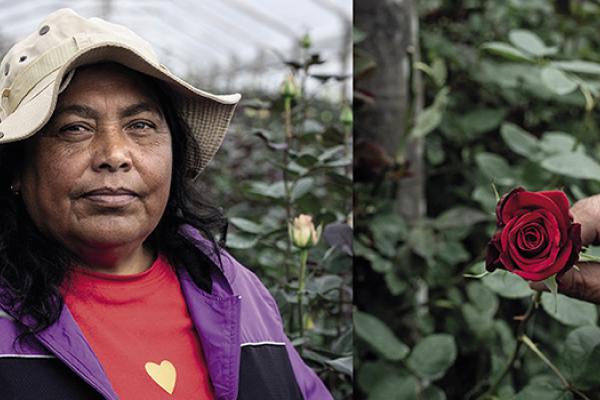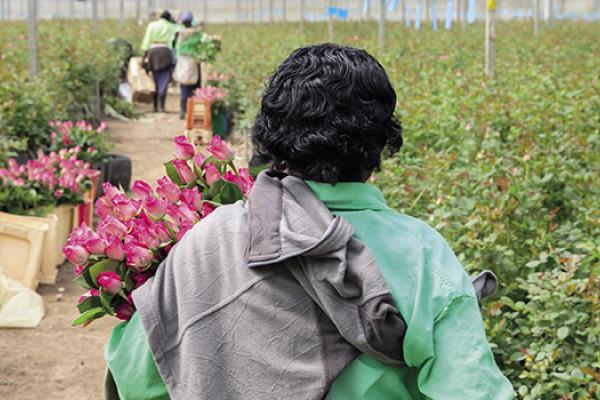

In Ecuador’s high Andes, roses bloom where cows once grazed. Beneath their flawless petals lies a human cost paid by those who grow beauty for the world to buy.
Scientific research links floriculture to lung disease, skin damage, depression, and neurocognitive problems in adolescents raised beside the plantations, where agrochemicals linger in soil, water, and household dust.
Yet demand from Europe keeps rising, especially around Mother’s Day and Valentine’s Day, when exporters race to ship millions of stems through Dutch auction houses and on to supermarket chains across the continent. With almost no binding limits on pesticide residues for cut flowers, European customers can buy cheap bouquets year- round, while the true price is paid, quietly, in the Cayambe valley.
This cross-border investigation combines immersive field reporting, data-driven research, and contextual analysis. The team’s journalistic approach rests on in-depth fieldwork that connects individual human stories with verified quantitative data and situates them within broader geopolitical and environmental contexts.
Key findings
- Cayambe (altitude ~3,000 m), together with the neighboring town Tabacundo, is considered one of the world’s most important centers for cultivating high-quality export roses. More than two billion stems are produced here each year, making Ecuador the third-largest exporter worldwide after the Netherlands and Colombia.
- However, working conditions are precarious (basic wage is $482, with unpaid overtime and no remuneration in the event of sickness), and the heavy use ofpesticides endangers the health of workers and residents in surrounding communities.
- Laboratory tests have shown that cut flowers imported from Ecuador and sold in Europe often contain alarmingly high levels of pesticides. In some cases, a single bouquet of Ecuadorian roses was found to carry residues of up to 39 different hazardous chemicals. Many of these pesticides are banned for use within the European Union.
- Although many hormone-active and carcinogenic substances may no longer be sprayed within the EU, European chemical corporations continue to produce them here and export large quantities abroad (about 122,000 tons of banned substances were exported from the EU in 2024, mainly to South America, the United States, and China).
- Cut roses from Ecuador are brought into the EU almost exclusively via the Netherlands, where they are relabeled and re-exported to the European market as Dutch roses, providing no clear information about the origin, local working conditions or pesticide use.
- Another highly problematic aspect of the expanding cut-flower industry is the growing scarcity of water, which comes at the expense of local households and small-scale farmers in the region.
Image © Johis Alarcón: Encircled by greenhouses and hazardous chemicals, Cayambe stands as Ecuador’s booming center of cut-flower production.