
The project reached both migrant communities needing essential resources and broader media, civic, and policymaking audiences through an expert panel debate and a cover dossier in Alternativas Económicas. Ultimately, it established a sustainable community for the group to officially incorporate as an independent association.

© Loa Fernández
On this page
Project Activities
Five two-hour workshops were designed by Alternativas Económicas, and 30 women caregivers obtained a certificate of completion.
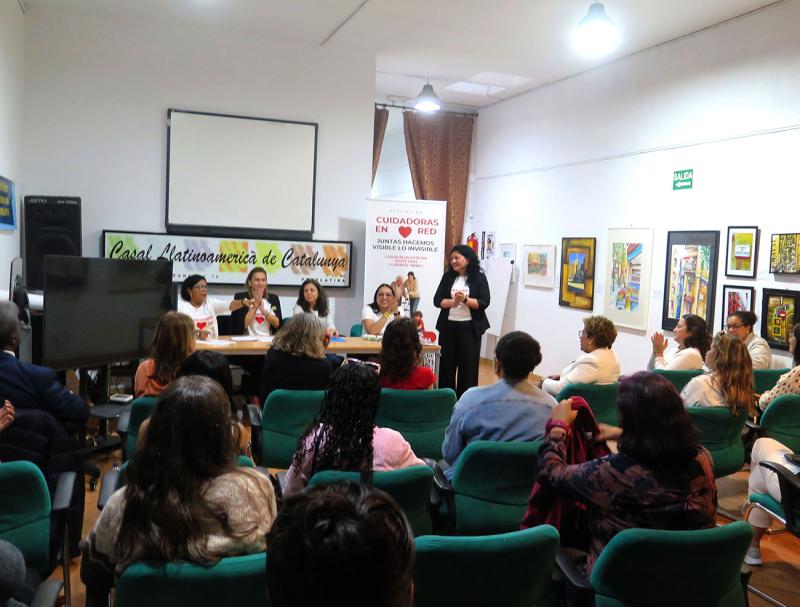
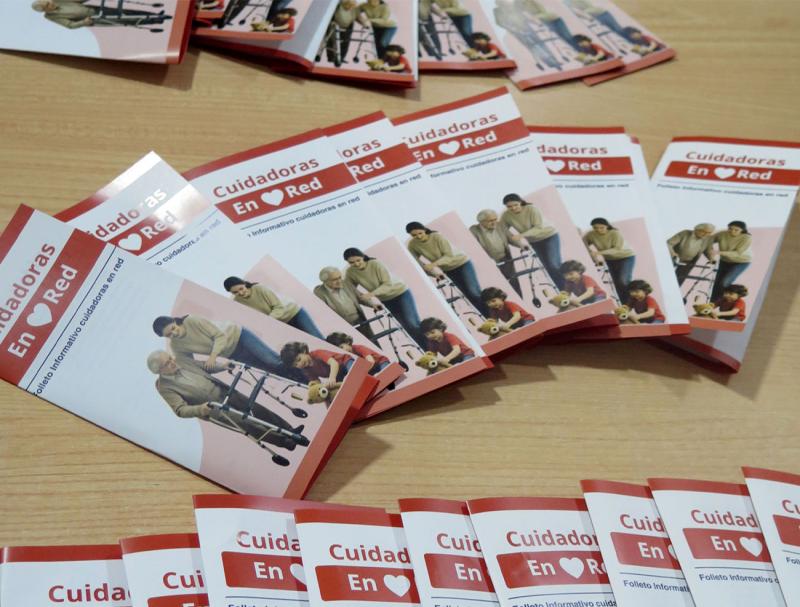
Four of these women were chosen to lead a communication campaign directed at peers in similar situations to inform and empower them regarding their rights and available resources, which they are often unaware of. With the project's support, they defined their key messages and selected their communication channels. The campaign ran for three months, and the participants drafted a founding manifesto for Cuidadoras en red, the women's community they created.
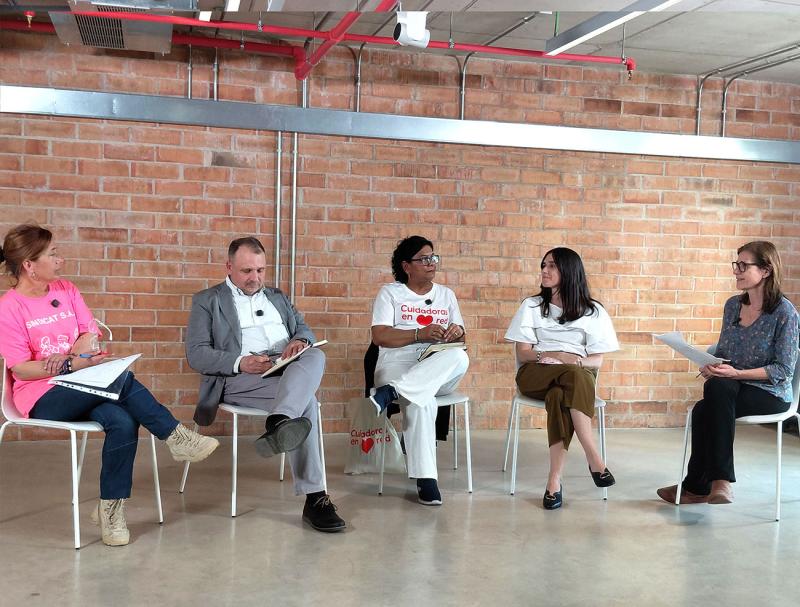
The project team hosted a panel discussion featuring expert voices to produce audiovisual content on the challenges facing the care sector, including invisibility and precarious working conditions. Four experts provided diverse perspectives spanning labour rights, public policies, women's support networks, and EU-funded academic research (Care4Care programme). The recorded debate was published on the project's website.
The magazine Alternativas Económicas produced and published a 15-page special dossier in both print and digital formats, highlighting the economic and social importance of care work. Across several articles, it analysed how care work serves as the primary entry point into the Catalan labour market for many migrant women, regardless of their prior formal training, while also evaluating the overall economic weight of the sector.
Alternativas Económicas launched a dedicated project website that will serve as a permanent resource hub, ensuring all training materials remain accessible to women interested in future learning opportunities.
What is the impact?
Alternativas Económicas is not a local outlet serving a geographically isolated news desert, but the project addressed a different, equally consequential form of information exclusion: an entire population — an estimated 96,000 people, 88% of them women, working in Catalonia's care sector, many undocumented and dispersed — who had no media coverage speaking to their reality and no channels of their own through which to access information about their rights, resources, or the public debate that concerns them directly.
Before the project, these women were structurally invisible both as subjects of journalism and as an audience: they were rarely represented in the press and had almost no means of receiving or producing information relevant to their situation. By combining public-interest journalism (the debate, the cover dossier "¿Quién nos cuidará?") with direct capacity-building (the digital communication workshops) and self-organisation (the "Cuidadoras en red" community and now-forming association), the project closed part of that information gap from both ends: it brought their reality into the magazine's editorial agenda and, simultaneously, gave the women themselves the tools to become producers and disseminators of information rather than remaining passive, unreached recipients.
The project team would evaluate this impact as modest in scale but structurally significant. The project did not aim to compete with mainstream media reach, but to build a durable, autonomous information channel for a community that previously had none — and that channel has continued to function and grow after the grant period ended, which the team considers the clearest evidence that a real gap has been at least partially filled rather than temporarily papered over.
The most tangible change is the consolidation of "Cuidadoras en red" as a living, self-sustaining community in Barcelona. Three months after the project's formal closure, the WhatsApp group has grown from 67 to 71 members, the broadcast channel from 79 to 89 followers, and the Instagram account from 192 to 209 followers. These increases may appear modest in absolute terms, but they represent genuine organic growth driven by word of mouth among a population with very limited prior experience of social media and, in many cases, low digital literacy — women who, at the start of the project, had never used these tools to organise, communicate, or advocate for themselves. That the community has kept growing without any paid promotion or continued project support is, for this specific audience, a meaningful indicator of ownership and sustained relevance.
Beyond the numbers, the community has become a genuine space of mutual support: participants exchange job leads, share information about the recent Spanish immigration regularisation process, recommend training courses, and pass along contacts for law firms and support organisations — practical, sometimes urgent information that these women previously had no reliable channel to access. This everyday exchange, combined with the drafting of a founding manifesto and the public presentation of the future association at Fedelatina, shows a shift from isolated, invisible workers to a connected community with its own voice, its own information network, and an emerging formal structure — a change the project team considers its most durable contribution to the region.
Project Pictures
Photos by Loa Fernández
© Lola-Fernandez
© Mariana-Vilnitzky
© Mariana-Vilnitzky
Media

Need resources for your own investigative story?
Journalismfund Europe's flexible grants programmes enable journalists to produce relevant public interest stories with a European mind-set from international, national, and regional perspectives.
Support independent cross-border investigative journalism
We rely on your support to continue the work that we do. Make a gift of any amount today.