
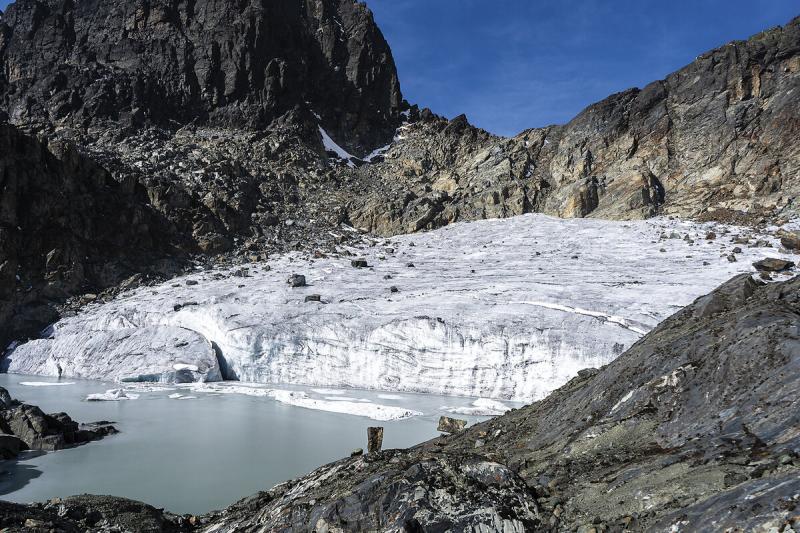
The world’s glaciers are melting faster than ever before recorded. But the tropical glaciers that hug the equator in the Andes, Southeast Asia, and Africa are especially vulnerable. South America’s glaciers are shrinking 35% faster than the global average, and a recent study of Indonesia’s Eternity Glaciers predicted they will be gone in five years. Meanwhile, the United Nations says that “according to available data,” East Africa’s glaciers will “very likely be gone by 2050.”
The glaciers on Mount Stanley form part of the Afro-alpine zone, an unusual ecosystem found at high altitudes in the African tropics. Here, giant groundsel plants rise out of the ground like 20-foot-tall candelabras. They grow alongside tubular giant lobelias whose drooping leaves provide shelter for the iridescent sunbirds that pollinate them. Plants and animals alike have adapted to the extremes of a climate often described as “summer every day and winter every night.”
The glaciers that flow from the Afro-alpine zone act as natural reservoirs for the communities below, storing water during wet, cold periods and releasing it in warm, dry ones. In those periods, people living downstream from the meltwater of Rwenzori’s glaciers depend on it to bathe, drink, and take care of their livestock.


