Across Bosnia and Herzegovina and North Macedonia, solar expansion is exposing weaknesses in how institutions protect agricultural land and oversee energy investments. This cross-border investigation examines how sites are selected, whose interests shape decisions and who bears the consequences.
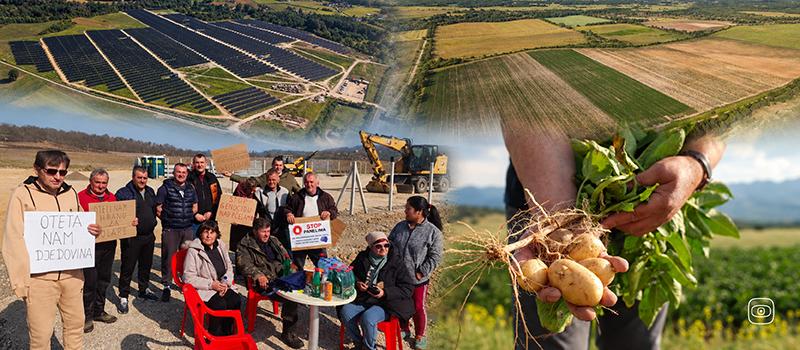
In Bosnia and Herzegovina, three locations reveal different stages of this process. In Podnovlje near Doboj, solar installations have been built on land subject to a long-running legal and social dispute. In Nevesinje, planned projects affect fields still used for food production. In Gacko and Avtovac, residents challenge proposed developments and changes in land use or classification.
In North Macedonia, the State Audit Office documented unlawful approvals, missing planning requirements and inadequate supervision. The investigation examines how legal provisions enabled solar development on fertile farmland, amid months of institutional silence and refusals to answer information requests. Proposed restrictions on farmland conversion, alongside the Agriculture Ministry’s acknowledgement of inadequate protection, signal belated recognition of weaknesses in the earlier framework.
Together, the stories connect local experiences with documentary evidence to expose the gap between renewable-energy ambitions and the institutions responsible for managing their consequences. They ask whether the green transition is being planned in the public interest and who is accountable when safeguards fail.
Key findings
Bosnia and Herzegovina
- In Podnovlje, solar installations are practically completed on land subject to litigation and local protests. A court ruling returned the land-registration procedure for reconsideration while construction continued.
- In Nevesinje, proposed solar developments affect agricultural plots still used for crops, including potatoes, bringing site selection and protection of productive land into local political debate.
- In Gacko and Avtovac, both the large SE Gacko scheme and smaller projects near settlements have prompted questions about land classification and residents’ participation.
- According to the BiH reporting, NOSBiH records approximately 13.5 GW of photovoltaic projects at different development stages. This is a project pipeline, not installed capacity or a forecast that every project will be built.
- The BiH cases reveal fragmented responsibilities for agricultural policy, spatial planning, concessions and grid development. They raise questions about whether these decisions adequately consider land quality and community impacts together.
North Macedonia
- The State Audit Office exposed systemic failures in solar permitting: approvals issued contrary to the law, missing planning requirements and inadequate supervision. Its findings show that the expansion of solar power outpaced the institutions responsible for regulating it.
- The Agriculture Ministry’s own assessment acknowledges that fragmented responsibilities, incomplete records and weak monitoring have left agricultural land inadequately protected amid pressure for conversion.
- The proposed Agricultural Land Law seeks to restrict the conversion of high-quality farmland for solar projects, while retaining an exception for public-interest developments in which the state is the dominant owner and investor.
- The investigation connects these institutional failures with the rules governing farmland conversion, asking whether stronger legal protection can prevent further loss of productive land without effective enforcement and accountability for earlier decisions.
Methodology
The investigation combines document analysis, field reporting, interviews and requests for public information. It compares how the two countries authorise solar development and address agricultural land, distinguishing announced projects, permits, construction and operational capacity. The comparison examines institutional decisions and their consequences without assuming that the countries have identical legal systems.
Bosnia and Herzegovina
The Bosnia and Herzegovina part of the investigation combines several months of field reporting, interviews, analysis of publicly available documents and Freedom of Information requests. Multiple field visits were carried out in Podnovlje near Doboj, as well as in Nevesinje (including Zlatac and agricultural plots where potatoes are grown) and in Gacko/Avtovac. Interviews were conducted with local residents, farmers, beekeepers, municipal assembly members, activists, agronomists, energy experts and civil-society representatives. The research analysed court cases and rulings, concession and regulatory documentation, solar project registers, strategic documents, agricultural-land legislation, environmental and spatial planning procedures, and plans for generation and transmission-grid development. Additional requests for information and comment were sent to public institutions, regulators, system operators and investors to verify findings and ensure the right of reply. Field findings were documented through photography and other visual material.
North Macedonia
The investigation combines the State Audit Office’s findings with legal analysis, public records and field reporting to examine how legislation enabled solar development on fertile agricultural land while institutional oversight failed. Months of institutional silence and refusals to answer freedom-of-information requests further obstructed scrutiny of these decisions.
Read alongside the Agriculture Ministry’s own assessment of inadequate land protection, the proposed restrictions amount to a belated acknowledgement that the earlier framework left even the most productive farmland exposed to conversion for solar projects. The investigation examines how those provisions were used over the years and who was responsible for protecting the land.