Overview and key criteria
The Invisible Life grant programme supports cross-border teams of professional journalists and/or news outlets with the aim to raise awareness, increase transparency and promote well-informed public debate on food and sustainability. The focus is on the lives and welfare of farmed animals. The programme is not intended to promote activism or a single point of view; rather, it seeks to bring together facts, context and diverse perspectives to enrich and better inform public debate.
Supported investigations must result in publications in at least two media outlets based in different countries. At least one of these outlets must be European and target European audiences.
Your proposal should include a hypothesis and proposed methodology for a journalistic investigation, as well as a detailed budget.
Financial assistance provided under this programme may cover costs related to working time and a range of expenses, including logistics, insurance, legal support, as well as access to technology and data sets.
In addition to funding, teams can get support from a mentor.
Grant rules
Please read in full before starting your application:
- The Invisible Life grant rules and eligibility criteria.
- Journalismfund Europe's General Grant Rules.
The Invisible Life grant programme is part of Journalismfund's Environmental Investigative Journalism Grant programme, which aims to give journalists the time, resources and independence they need to shine a light on under-exposed issues related to farm animal welfare, which is supported by Coefficient Giving.
Thematic focus
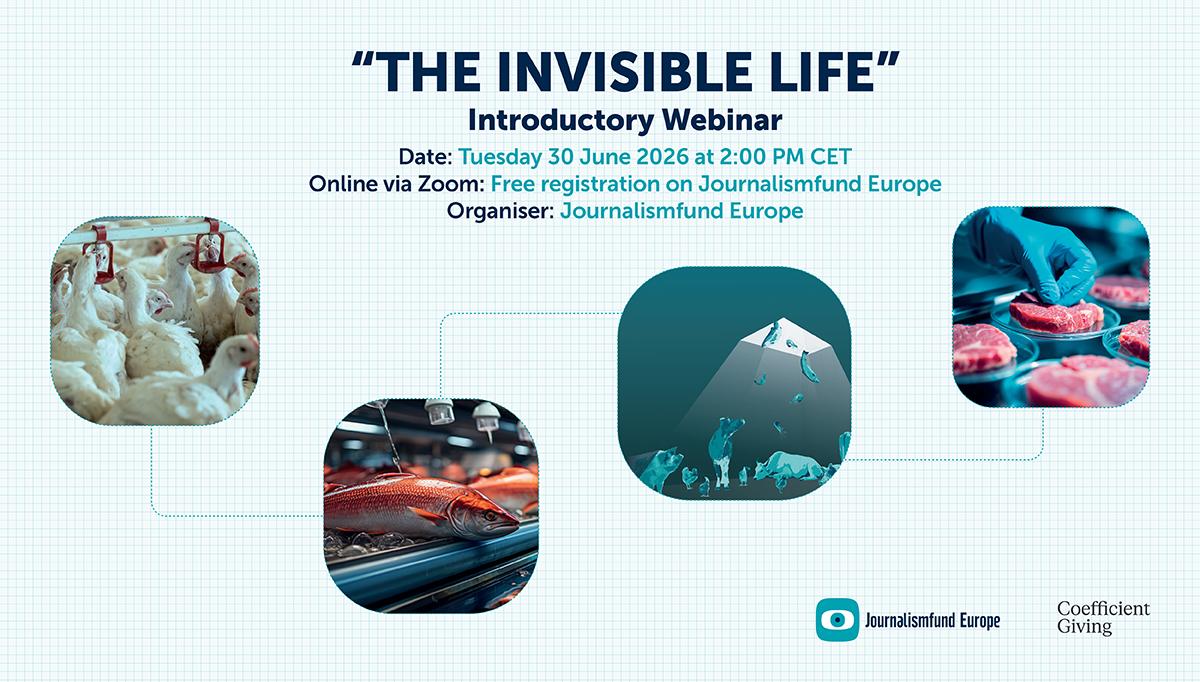
Many of the animals raised for food — including chickens, pigs, cattle, and farmed fish such as salmon, tilapia and sturgeon — remain largely hidden from public view. How these animals live, and how their production is organised, is rarely examined in detail, nor are the wider social consequences. Yet despite its close links to human health, the environment, food security and sustainability, this area attracts relatively little research funding or philanthropic support.
The applications should focus on the welfare and living conditions of farmed animals, particularly in intensive livestock and commercial fish farming, with related topics including supply chain regulation and transparency and the links between animal welfare and public health. Stories examining economic pressures on producers, alternative production models, or trade flows are eligible where they connect clearly to animal welfare. In particular, investigations into chickens (broilers and laying hens), farmed fish, and pigs — species that are numerically significant but frequently underreported are highly encouraged.
Although animal welfare is not a distinct UN sustainability objective, it intersects with goals on health, responsible consumption, climate and biodiversity in which journalism can broaden the conversation about how food are produced and consumed, on land and water.
Building a team and a successful collaboration
We have some tips on how to find investigative journalists in other countries to team up with, as well as some advice from our grantees and other experts on making this collaboration work. Find them here.
Application process
To see all the details about the eligibility and assessment criteria, timing, jury and grant conditions, visit our application portal.
Please be advised that if any details (such as full addresses) or documents (IDs, CVs, articles of incorporation) are missing when your application is submitted, it will be considered ineligible.
Need help?
We are interested to hear your ideas and to assist you with any questions. Please do not hesitate to contact us via:
- Telephone: +32 2 304 73 66
- Mail: invisiblelife@journalismfund.eu
- Or schedule a videocall