Journalismfund Europe works with a separate independent jury for each of its grant programme. Our jury members remain anonymous until they leave the jury — this helps us to avoid any conflict of interest and ensures both the quality of the assessment and the confidentiality of the submitted proposals.
All of the juries consist of experienced journalism and media experts. After a juror's mandate has ended, we finally make their identities public as a means of transparency and recognition for the crucial role they play in evaluating and selecting granted projects.
All ten jurors brought extensive experience in media, investigative, local issues and media management, adding significant value to the selection process, and we would like to thank them for their remarkable contribution to the success of our grant programmes.
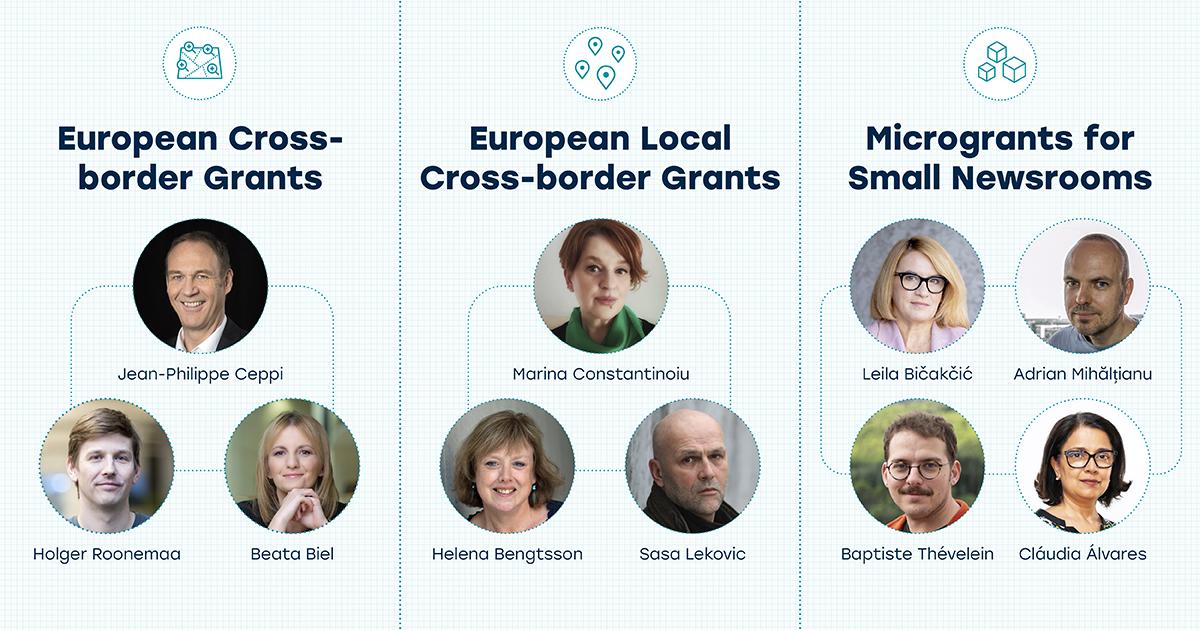
European Cross-border Grants
The ECB jury, of which Beata Biel, Jean-Philippe Ceppi, and Holger Roonemaa were part of, evaluated applications for the European Cross-border Grants, which focused on cross-border investigations and for research on European topics.
"The strongest proposals always have three things. First, a really strong hypothesis that the team sets out to investigate. This helps the jury to understand clearly what the story will be. Secondly, a hypothesis remains just a guess unless it is backed up by actual pre-research. A strong preresearch shows that the team is not only hoping to prove something but they have a viable minimum story in sight. And thirdly, the team needs to show a clear way forward - how do they intend to prove the story they proposed.
Sometimes we saw pitches where it was difficult to understand what would be the new added value compared to what has already been reported on the topic. It is good to make this clear, it will help the jury decide and it sets your project proposal aside from the rest. – Holger Roonemaa, European Cross-border Grants juror
304 proposals
Jean-Philippe Ceppi was a jury member from February 2020. Beata Biel started her term as a juror from March 2023 and Holger Roonemaa served as a juror from June 2024. All of them ended their term in April 2025.
For the European Cross-border Grants (PluPro project), they assessed 304 proposals, and granted a total €1,317,967 to 80 projects.
You can view the supported European Cross-border Grants projects here.
Beata Biel
Beata Biel is an award-winning Polish journalist, editor, and media manager with more than two decades of experience in TV documentary reporting and newsroom leadership. Over the course of her career, she has mainly worked for TVN/TVN24, contributing in-depth stories focused on crime, disinformation, and the intersection of technology and society. At TVN24 she also led and co-develop Konkret24, a fact-checking project. In 2020, she assumed the role of Director of News Development and Premium Digital News at WBD TVN.

Jean-Philippe Ceppi
Jean-Philippe Ceppi is a Swiss investigative journalist and historian born in Lausanne in 1962. He holds degrees in arts, an MBA, and a PhD in contemporary history, and has worked as an investigative reporter and foreign correspondent since 1987, notably in Africa for outlets including Radio France Internationale, the BBC, Libération, and Swiss Radio. Awarded the Jean Dumur Prize for his reporting on the Rwandan genocide, he later led investigative journalism at Le Temps and spent two decades as editor-in-chief and producer of Temps Présent, Swiss public television’s flagship investigative programme, before returning to field reporting in 2024. He is also an ethics advisor for RTS, a founder of Swissinvestigation.ch, an active figure in the global investigative journalism community, a lecturer at the University of Neuchâtel, and a recognised expert on Rwanda and genocide-related judicial proceedings.

Holger Roonemaa
Holger Roonemaa is a Tallinn-based investigative journalist specializing in Russia-related security, intelligence, hybrid warfare, and money laundering. He is Head of the Investigative Desk at Delfi Estonia and a Member Center Editor at OCCRP, and founded Delfi’s investigative team in 2020, leading it to win Estonia’s Bonnier Prize for Investigative Journalism four consecutive years while being named Journalist of the Year twice. A leader of major cross-border investigations with networks such as OCCRP and the ICIJ, his work exposing Russian sabotage, illicit finance, and disinformation has influenced public debate and policymaking, and earned international recognition including nominations for the Daphne Caruana Galizia Prize. In 2024–2025, he was a Knight-Wallace Fellow at the University of Michigan, focusing on investigative journalism, open-source intelligence, and security reporting.

European Local Cross-border Grants
Marina Constantinoiu, Helena Bengtsson, and Sasa Lekovic were members of the jury of the European Local Cross-border grant, which focused on cross-border collaborative investigations focusing on localised issues in Europe.
"Most challenging was to fully understand the projects so that it was possible to make a fair assessment of the finished product. But that was also the rewarding part - to learn about all the amazing stories and ideas that the journalists from all over Europe wanted to work on.
Also, to be able to discuss journalism with the other members of the jury, highly competent journalists that freely shared their knowledge and experience." – Helena Bengtsson, European Local Cross-border grant juror
175 proposals
The jury members fulfilled their responsibilities from July 2022 until April 2025. For the European Local Cross-border Grants (PluPro and CBL projects), they assessed 175 proposals, and granted a total €1,305,216 to 94 projects.
You can view the supported European Local Cross-border Grants projects here.
Helena Bengtsson
Helena Bengtsson is the data journalism editor at Gota Media and Bonnier News Local, two regional publishing companies in Sweden with 55 local titles. She previously worked as the data journalism editor at Sveriges Television, Sweden’s national television broadcaster, for 27 years and has also served as Editor, Data Projects of The Guardian UK between 2014-2017. She was awarded the Stora Journalistpriset (The Swedish Grand Prize for Journalism) in Sweden twice, in 2010 and in 2016 for innovator of the Year.

Marina Constantinoiu
Marina Constantinoiu is a Romanian journalist with nearly 35 years of experience across radio, print, news agencies, and online media, having held senior roles including Head of the Foreign Desk, Deputy Editor-in-Chief, Editor-in-Chief, and Project Coordinator. A journalism graduate of the University of Bucharest, she is a board member of SEEMO and a member of EJA and CLEW, has received multiple investigative journalism awards, and is an alumna of the Robert Bosch Foundation’s *Reporters in the Field* and the IJP programme. She also teaches MA students at the Faculty of Journalism and Mass Communication at the University of Bucharest.

Saša Leković
Saša Leković is a Croatian journalist with over 46 years of experience and President of the Investigative Journalism Center (CIN), having also served as President of the Croatian Journalists’ Association from 2015 to 2018. A freelance reporter, editor, trainer, and media consultant since 2003, he is a founder of *Jutarnji list* and of Croatia’s first private newspaper, with extensive experience across print, radio, television, and digital media in Croatia and the wider South East Europe region. An accredited investigative journalism trainer, he has worked with hundreds of journalists worldwide and is one of the founders of the Global Investigative Journalism Network.

Microgrants for Small Newsrooms
Cláudia Álvares, Leila Bičakčić, Adrian Mihălțianu, and Baptiste Thévelein were members of the jury which empowered 50 local independent media outlets to foster their resilience and viability through capacity-building activities, innovation driven by design-thinking practices, and the creation of a repository of case studies and best practices.
"The most rewarding aspect was the opportunity to take a step back and see how deeply committed European media leaders are to their audiences, often under extremely difficult conditions. Reviewing such a broad range of projects was also intellectually enriching: it allowed me to understand emerging trends, new collaborative methods, and the evolving needs of newsrooms all over Europe. The most challenging part was having to make decisions knowing how much effort and hope applicants put into their proposals." – Adrian Mihălțianu, Microgrants for Small Newsrooms juror.
139 proposals
The jury members accomplished their duty during two rounds of funding cycles from February 2025 until May 2025. For the Microgrants for Small Newsrooms, they assessed 139 proposals, and granted a total €249,237 to 51 projects.
You can view the supported Microgrants for Small Newsrooms projects here.
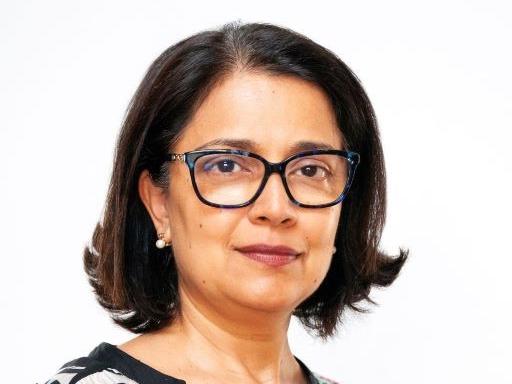
Cláudia Álvares
Cláudia Álvares is Associate Professor (with Habilitation) of Media and Communication at Iscte – University Institute of Lisbon, where she coordinates the Master’s in New Media Management and integrated researcher at the Centre for Research and Studies in Sociology (CIES). She is elected member of the Academy of Europe since 2020 and former president of the European Communication Research and Education Association (ECREA) (2012-2016). Her research examines processes of discourse and mediatisation, with a critical focus on gender politics, populism, digital media, and contemporary transformations of the public sphere.
Leila Bičakčić
Leila Bičakčić is a founding member and leader of the Center for Investigative Reporting (CIN), an award-winning nonprofit newsroom in Bosnia and Herzegovina known for exposing corruption, political–criminal links, and the misuse of public funds, with investigations leading to major indictments and court verdicts. Under her leadership, CIN has received numerous national and international honors, including the Daniel Pearl and Shining Star awards, and was a finalist for the 2021 European Press Prize for an investigation into vote-buying. Based in Sarajevo, she oversees CIN’s strategy, investigative planning, and development, with a focus on sustainable media models, digital transformation, and media innovation in the Eastern Balkans.

Adrian Mihălțianu
Adrian Mihălțianu (PressOne, Romania) is a journalist with more than 19 years of experience, both in editorial and management teams for medium-sized and large media companies. As publisher of PressOne, he brought the publication from a one-donor model to a sustainable, complex mix based on subscriptions and strategic partners supporting its investigations and storytelling. Mihaltianu has also been published as a science-fiction writer and received the Siemens CEE Press Award 2019 for an article about how Industry 4.0 will impact our lives.
Baptiste Thévelein
Baptiste Thévelein is the co-founder and executive director of Médianes, a France-based organization dedicated to supporting media outlets and their leadership. Médianes combines a media publication with a design, marketing, strategy, and management studio that has supported more than 100 newsrooms across Europe. Médianes also coordinates Sphera, a European network of independent and public-interest media. Baptiste specializes in media business models, digital and technical strategy, and organizational and managerial structures for news organizations. He works closely with newsroom leaders, publishers, and media founders to help them build sustainable, audience-driven, and resilient media organizations.
---
The PluPro project distributed 2,230,000 euros among journalists and media (national and local) in Europe to set up transnational investigations together. At the same time, journalists and media received newsroom training, scholarships, and mentoring in addition to financial support.

The PluPro project is a 24-month project co-funded by the European Union, Vereniging Veronica and Limelight Foundations and implemented by the consortium of Journalismfund Europe and Transitions.