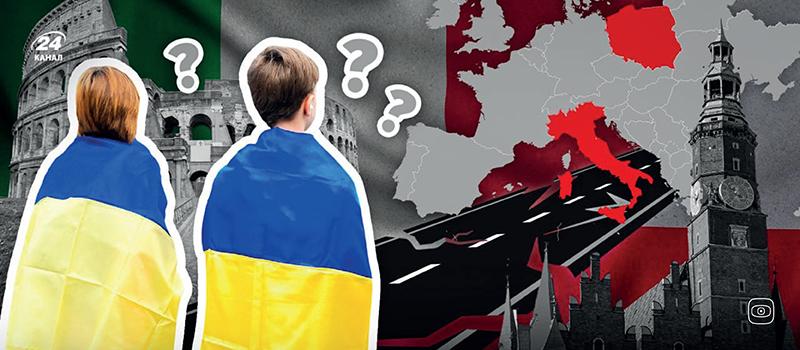
The arrival of millions of Ukrainians in 2022 is remembered as a unique act of European solidarity, and it was one. For the first time, temporary protection was activated, and people fleeing the war received legal status, the right to work, healthcare and freedom of movement almost overnight. In Italy, around 170,000 people found shelter, mostly in the homes of relatives, the long-established Ukrainian community and Italian families who opened their doors within days. In Poland, a country more used to sending people abroad than receiving them, an emergency law gave refugees equal access to healthcare and child benefits, and civil society took in hundreds of thousands of people.
This story also has a darker side. More than four years later, the emergency has not ended, and protection that was meant to be temporary has become a permanent state of uncertainty. Permits are still renewed one year at a time, now up to March 2028. Every extension or legal change arrives late and unpredictably, and none of these years count towards a lasting status. Many refugees, for their part, still live with a suspended migration project. They did not choose to leave, they see their stay as a pause, and they put off learning the language or planning a future, because giving up on return feels like a surrender.
Key Findings
- Prolonged temporariness has shown what happens when a status built for a short emergency is stretched over years. Every renewal puts access to healthcare, family benefits and housing at risk, and every announced legal change sends people rushing to offices to secure their rights. Bureaucracy creates closed circles. Without a registered address there is no ID, without ID there is no bank account, and without a bank account a person with a job cannot be paid. Welfare and social housing schemes require permits or years of residence that a one-year status can never provide. The new routes to longer-term permits reward those with stable contracts and leave the elderly, carers and single mothers behind. As collective accommodation closes, some people fall into homelessness, including men sent back from other EU countries.
- The assumption that people who arrive in need, and who are foreigners, should accept whatever they are offered. The investigation found it at every step. Many people end up in informal sublets, and some are asked by agents for upfront fees. Landlords demand deposits worth several months of rent, hang up when they hear a foreign accent, or blame a whole nationality for one tenant's damage. Doctors, engineers and pharmacists clean houses because recognising a diploma is costly and slow. Some employers expect gratitude and silence instead of fair pay. Those who ask questions or claim their rights are quickly labelled demanding. The Ukrainian experience makes visible a mindset that weighs on everyone who depends on the reception system.
- Scattered across both countries, there are also examples of good integration. They tend to appear where the local community plays an active part and where a Ukrainian community was already present: parishes, local associations, Caritas networks, diaspora organisations and families who stayed by people's side for years. Most households have at least one member in regular work, and many have rebuilt a fragile stability. These successes, however, depend on goodwill rather than on the system. Volunteer support faded within one or two years, public attention dropped, and in both countries political tensions, sensationalist media and disinformation eroded the early solidarity. The system keeps confirming and perpetuating the mechanisms that weigh on refugees' future and on their mental health. Living from one deadline to the next creates constant anxiety. People cannot plan six months ahead, and many spend years in reception facilities, losing hope without gaining a plan. Families are split by conscription rules, and some parents have not seen their children for years. Many grieve the professional identity they built at home. Everyday hostility, online attacks and a silence that keeps most victims from reporting abuse add fear to uncertainty.
Methodology
The project brings together a team working in Italy, Poland and Ukraine and uses the same method in both host countries. For more than six months, the team conducted in-depth interviews with researchers, reception coordinators, social workers, cultural mediators, housing specialists, civic activists and psychologists, and gathered personal testimonies separately from refugees of different ages and backgrounds. In Italy, fieldwork covered Lombardy, Veneto and Trentino. In Poland, interviews were combined with a mystery-call investigation of the rental market in six cities. The research was also enriched by a conversation with project advisor Nellija Locmele, who provided an additional perspective on the issues explored. Interviews with Ukrainian and European experts on migration policy, return prospects and integration indicators frame both national cases.