For people, economists warn, the risk of corporate consolidation is that cost savings are converted into profits rather than lower prices, even as payments to farmers are squeezed.
Concentration in the meat and dairy sector is a Europe-wide phenomenon that, in the United Kingdom, reaches extremely high levels.
Eight companies control between 70 and 85 per cent of the British meat market (estimated at 22 billion pounds), whilst five companies account for almost 60 per cent of the dairy market (estimated at 11.9 billion). In the pigmeat sector, Cranswick, Karro, Dunbia UK and Pilgrim’s Europe alone control around 90 per cent of the country’s total production, whilst Pilgrim’s Europe also controls around 30 per cent of the chicken meat market.
In Italy, the ten leading companies in the processing of dairy products, meat, sausages and eggs account for 38.1 per cent of the industrial sector of the dairy, poultry, beef and pig supply chains combined. This amounts to €17.2 billion, a considerable figure that illustrates the degree of concentration in this important economic sector, which, according to the Institute for Agricultural and Food Market Services (Ismea), is worth around €45 billion. If we consider meat production alone, the value rises further, with the five largest companies controlling over half (51.7 per cent) of the market, worth just over 12 billion euros.
Many of these Italian companies are part of even larger groups that manage many stages of the meat and dairy supply chains, as part of a process of increasing vertical integration. In most cases, they are owned by Italian families.
In Spain, where the market is growing very rapidly, the situation is similar to that in Italy. In 2024, the total turnover of the meat sector reached 41.34 billion euros, an increase of almost 70 per cent compared with five years earlier. In this context, the top five processing companies accounted for almost 30 per cent of the sector’s total turnover.
The vertical integration of the supply chains is also similar to that in Italy, and even greater. Vall Companys, for example, directly controls feed mills and thousands of livestock farms, slaughtering 5.5 million pigs and 160 million chickens a year. Guissona, which began as a co-operative, has gone on to own a bank and a supermarket chain, BonArea – a move that no major group in Italy has yet made.
Finally, in Spain, as in Italy, the leading meat companies are family-run: eight of the ten largest, in addition to the Italian Pini group. The United Kingdom, on the other hand, stands out in this respect as well: foreign capital controls around 40 per cent of the British meat market and over half of the dairy market.
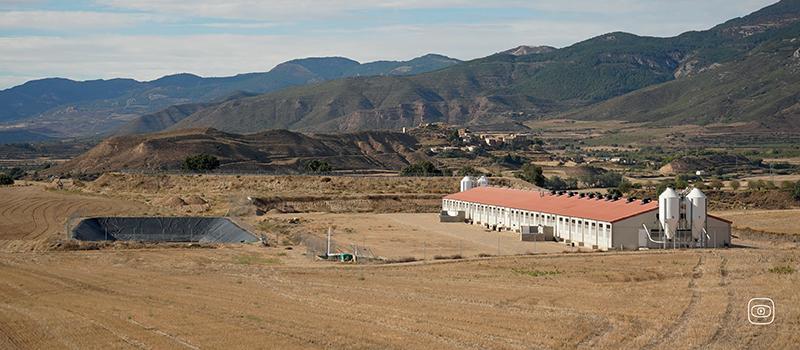
Image by Laura Villadiego: A large livestock farm in Spain.