Over the past two decades, Europe's appetite for shrimp has grown sharply. But local production meets barely one‑third of that demand, with the remainder coming from abroad. Once dominated by India and Vietnam, this market share is now led by Ecuador, which accounts for more than half of all imports. To keep up with rising demand, farms have pushed deeper into coastal areas already worn down by decades of mangrove deforestation. Between 1969 and 1999, as shrimp farming spread across the country, Ecuador lost as much as 43% of its mangroves.
Mangrove clearing is now banned in Ecuador, and the industry insists that habitat conversion has dropped to nearly zero despite soaring production. But while large‑scale clearance may be a thing of the past, residents of fenceline coastal communities – often among the country's poorest – and scientists say the destruction of mangroves is far from over. This investigation follows shellfish harvesters, crabbers, and fishers who depend on mangroves for their livelihoods as they describe smaller, harder‑to‑spot encroachments and other damage such as untreated wastewater discharged into estuaries.
Their testimonies are supported by satellite data, scientific studies and complaints showing that mangrove loss and ecological degradation have continued even inside legally protected areas. In numerous accounts, residents described environmental degradation so severe that it eroded their ability to feed their families. The story also examines Ecuador’s community mangrove custody agreements, a conservation model that gives local associations responsibility for protecting mangrove forests. While praised as innovative, the system often leaves poor communities to patrol, document and denounce damage with little support from the state.
Unlike the impacts of shrimp farming in Asia, which are well documented and have long attracted international scrutiny, Ecuador’s model has received comparatively little attention. And most European shoppers remain unaware that the frozen shrimp in their supermarket freezers may come from there. That information gap is partly structural: a 2024 report found that 63% of processed seafood products sold in the EU provide no country-of-origin information, while many of the remaining labels are incomplete or difficult to interpret.
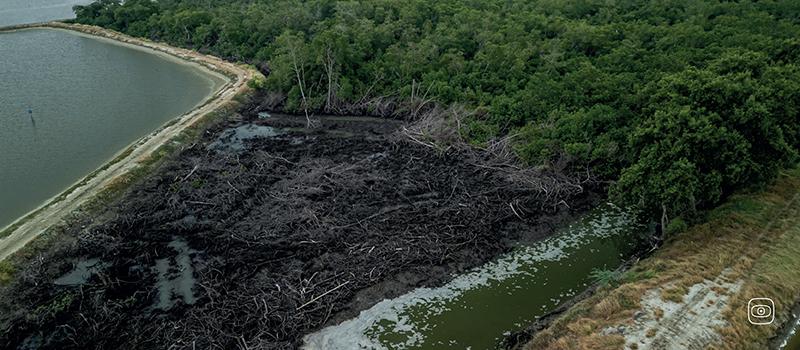
Image by Vicente Gaibor: A shrimp farm discharging wastewater into a mangrove patch near Isla Costa Rica, a small island in the Jambelí Archipelago.