Our research examines this issue across three countries: Scotland and Italy, where immigration is a key feature of the social fabric, and Romania, where Roma communities represent a significant ethnic minority. Across these contexts, Roma and Black migrant families face distinct but overlapping forms of marginalisation, making them critical case studies for understanding how state interventions affect vulnerable populations across Europe.
In Italy, systemic discrimination against Roma families has been repeatedly condemned by the European Court of Human Rights. Yet, despite these rulings, authorities continue to rely, formally or informally, on ethnicity and cultural norms in assessing parental capability. Social services frequently lack the cultural competence necessary to respond sensitively, particularly in cases involving unreported domestic violence, where assumptions about cultural norms may override facts.
In Romania, data transparency is a major obstacle. The absence of ethnicity-disaggregated data on child protection makes it nearly impossible to measure the true impact of family separations on Roma communities. Furthermore, such interventions have been politicised by far-right actors who have used isolated incidents, often abroad (such as the Harehills riots), to vilify social services, stirring fear among Roma families and fuelling public misinformation and protest.
In Scotland, we have investigated how immigration enforcement intersects with child welfare systems. We’ve spent time with grassroots organisations in Scotland and London, hearing from them about how the lack of support at an early stage and an overly interventionist approach sees migrant children removed from their homes. We investigated the case of Nina, a mother from Southeast Africa, whose children were first taken into care while she was detained on immigration grounds, with four of her children eventually going into the care system. However, a detailed assessment later found that concerns that led to their removal stemmed in part from cultural misunderstandings and discrimination. Years later, her son died by suicide, laying bare the high stakes involved.
Organisations claim her story has echoes of the stories of many racialised and migrant mothers who lose custody of their children due to a combination of their unfamiliarity with local laws and a lack of cultural understanding in Scotland’s child protection system.
Impact
Laura Ghiandoni presented the findings from the investigation at two editions of the General Affairs of Migration (Stati Generali della Migrazione) programme, organised by Conadimi (National Coordination of Diasporas and Migrations), on 30 May and 18 June.
The meetings took place on 30 May in the Sala del Carroccio on Rome’s Capitoline Hill and on 18 June at the Italian Senate, as part of a national consultation process on migration, rights and labour. The event in the Senate was organised following the initiative of the senator Sabrina Licheri, of the Five Star Movement party. A further institutional session is scheduled for September 2026 at the Chamber of Deputies.
The Stati Generali della Migrazione aims to bring together institutions, diaspora organisations, experts and civil society representatives to contribute to a more inclusive and future-oriented approach to migration policies in Italy. Conadimi describes the initiative as a participatory process under the slogan “Let’s build the future of migration together.”
During the discussions, Ghiandoni explained more about the roles who help prevent cultural misunderstandings between migrants and Italian institutions. The exchanges highlighted the role of intercultural mediation and other professional figures in facilitating communication, improving access to public services and strengthening trust between institutions and diverse communities.
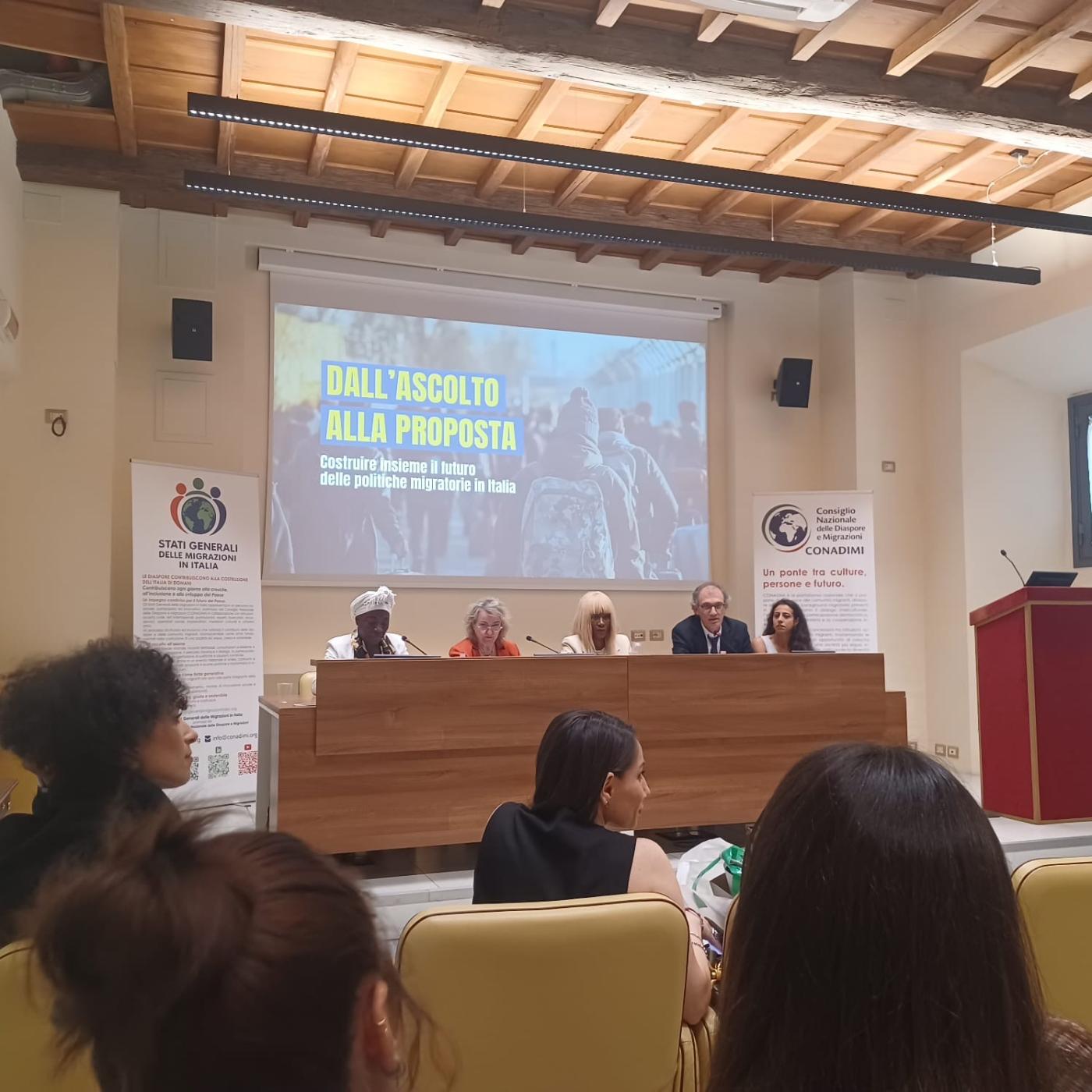
The events formed part of a broader dialogue on migration governance, inclusion and rights. Participants explored ways to improve institutional responses to Italy’s increasingly diverse society, while emphasising the importance of evidence-based research and journalism in informing public debate on migration.
Illustration by Catherine Weir