The concept of expert-reviewed journalism was introduced to journalists in conjunction with the launch of the 2026-27 European Cross-border grant programme, earlier this year.
Stéphane Horel, investigative journalist with Le Monde, along with journalists Elisabetta Tola of FACTA.EU, Zeynep Sentek and Leopold Salzenstein of Arena for Journalism in Europe led a series of online sessions showcasing case studies of journalists collaborating with professionals who leveraged their expertise to help a reporting team navigate the technicalities of the topics they investigated.
BEST PRACTICES
While there were no recordings made of those sessions, what follows is a summary of the key advice and best practices for engaging in a successful partnership with experts.
- Reach out to the expert early. Getting the ball rolling ensures you have time to build a relationship of trust with an expert, as there are many facets of the work to agree on.
- Journalists must be as knowledgeable as possible on the subject-matter they’re seeking to engage an expert on. This is to demonstrate your credentials for initiating the project and as a potential collaborator. Show and tell of your abilities by sharing previously published work on the topic and engaging on existing research by the expert and their peers.
- Prepare a set of reasons why an expert would benefit from getting involved in your research project. This will usually be about enhancing the visibility and potential impact of their work through communicating with a large audience and being creative in doing so.
- Be clear about your hypothesis and the objectives of your research. Outlining the end goal helps to get everyone on the same page. Don’t seek an expert solely for a flashy quote to underpin your own research.
- Explain your existing or proposed research methods, tools and data analysis process. Clarifying these technicalities, especially on paper, helps to frame the strength and potential weaknesses of the project. Identifying your team's gaps in skills and knowledge will help the expert prepare to patch them.
- Discuss and agree on the various contributions expected from the various parties based on capacity, expertise, funding, and interest. This is better done by setting up an MoU. Partnership agreements may be required for an expert to be involved, depending on the policies they adhere to for their work.
- Discuss the question of paying the expert from the start. The aim is to facilitate expert contribution while making sure no conflict of interest exists. Agreeing on an official partnership and funding can take time.
- Nominate one person to coordinate the relationship with the expert to streamline and facilitate communication. This person's responsibility is to see the bigger picture, avoid getting bogged down in the tunnel vision an expert might pursue, and lead to the journalistic output.
- Decide on the outputs for the research and crediting related to the expert's involvement. This creates transparency and helps to reflect the expected levels of responsibility behind the work.
Below are the slide decks to dig further into the materials and tips shared by the speakers listed above.
Forever Pollution Project / Forever Lobbying Project and ECB Intro Webinar presentation slide deck.
Wasted Wetlands project and presentation slide deck
Green to Grey project and presentation slide deck
How to save the planet (and its people) with nerds and the presentation slide deck.
Expert-reviewed Journalism References
The Forever Pollution project, which helps to map the listed of PFAS contaminated sites across Europe, has helped to demonstrate how an expert-journalist collaboration can function. Their “expert-reviewed journalism” approached involved 29 journalists and seven scientific advisers. Following the completion of the project, the investigative team explained their work and developed a methodology in an article titled "PFAS Contamination in Europe: Generating Knowledge and Mapping Known and Likely Contamination with “Expert-Reviewed” Journalism", published in the Environmental Science & Technology journal in April 2024.
Since then, the clear delineation of this approach has inspired discussions and plans for replication across journalistic, scientific, and regulatory circles. The reporting team has received numerous awards for their work. The database created through the project has been used in ten different research projects.
The Green to Grey project, published in 2025, is a cross-border collaboration led by Arena for Journalism in Europe, bringing together journalists and a scientist from across eleven-country to report on Europe's disappearing nature. The team produced a clear outline of their methodology and their approach to this investigation is the subject of an article in Nature Communications titled "Europe’s land take and the loss of nature and cropland to artificial surfaces".
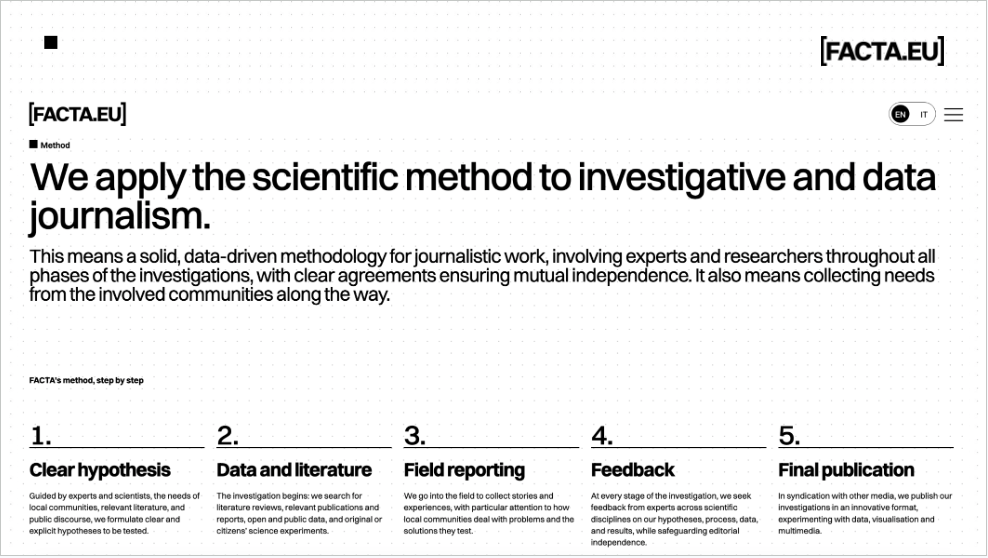
FACTA.EU, led by Elisabetta Tola, was one of the members of the Green to Grey reporting team and also led the Wasted Wetlands project. Tola's presentation outlined the process her organisation follows for engaging with experts throughout the reporting and until publication.
The aim of the expert-reviewed journalism scheme of the European Cross-border grant project is to foster projects where collaboration between journalists and experts is central to the investigative work. The grantees who receive support from this scheme are connected with a project advisor, who helps them to guide their journalistic research, and an expert to deepen their investigative methods and understanding of the technicalities of their topic. The European Cross-border grant programme provides additional funding to pay for their involvement.
At the end of this programme, Journalismfund will produce a report evaluating the success of this scheme and the key takeaways from fostering this type of collaboration.
-----
The European Cross-border grant programme is operated by Journalismfund Europe. Our consortium partners, the Stockholm School of Economics in Riga (SSE Riga), run the Sustainability and Media Management Training programme. The programmes are co-funded by the European Commission and Stichting Veronica.
Co-funded by the European Union. Views and opinions expressed are however those of the author(s) only and do not necessarily reflect those of the European Union or European Education and Culture Executive Agency (EACEA). Neither the European Union nor the granting authority can be held responsible for them.