The shortlist was drawn up following a pre-evaluation by independent assessors at Leipzig University, convened by the European Centre for Press and Media Freedom (ECPMF). An independent jury will choose three winning teams, each receiving €5,000.
The shortlisted investigations were produced by nearly 600 journalists from 63 countries in total, including 26 EU member states. The projects span a geographical range stretching from Iceland to Uganda.
The five investigations realised with support from Journalismfund Europe:
This cross-border investigation uncovers how Romanian, Moldovan, and French security contractors deployed to support the Democratic Republic of the Congo’s army operated as alleged mercenaries in violation of international law. Drawing on leaked communications, official documents, and extensive interviews conducted across DR Congo, Romania, Moldova, and France, the investigation reveals that some contractors lacked military training, participated directly in combat, and supported sanctioned armed groups accused of war crimes. It also traces the financial and political network surrounding the operation’s leader, exposing the use of offshore companies to conceal payments from the Congolese government, investments in Romanian real estate, and connections to influential political, judicial, and business figures, raising serious questions about accountability, corruption, and oversight.
A cross-border investigation into unequal access to abortion in Europe. The team documented, for the first time, how many women each year are forced to cross into another country to obtain an abortion: at least 5,860 women in 2023, and more than 25,000 since 2019. The journalists filed more than one hundred freedom-of-information requests, mapped the laws and protocols surrounding abortion across European countries, and spoke to dozens of women who had to travel abroad for an abortion, as well as numerous experts. The investigation maps not only the routes and numbers involved, but also the underlying causes, the failures of governments and authorities, and the impact on those forced to travel.
Factories on the Run: Inside the Global Trade That Moves PFAS Downstream
This investigation follows what happens to a Western chemical plant after it is forced to close following an environmental disaster. The Italian company Miteni, active since 1965 in Trissino (Vicenza), caused one of Europe's largest PFAS pollution incidents, leaving 350,000 local residents with elevated concentrations of these "forever chemicals" in their blood — substances linked to infertility, cardiac disease and cancer. Miteni went bankrupt in 2018; in June 2025 former executives were sentenced to a combined 141 years in prison, a landmark ruling that established criminal liability for large-scale PFAS pollution in Europe for the first time. The plant itself, however, did not disappear. An Indian company bought it, dismantled it and rebuilt it in the chemical hub of Lote Parshuram, south of Mumbai. Since 2025 the plant has resumed production, selling the same PFAS substances to old and new clients worldwide, in a country that still has little environmental regulation or monitoring in place. The investigation caused considerable public reaction in India.
An investigation by 46 journalists and 18 academics from 16 countries, coordinated by Le Monde, into how the PFAS industry and allied organisations ran a lobbying and disinformation campaign over more than a year to water down a proposed EU ban on "forever chemicals". The team produced the first estimate of the financial impact of that delay: more than €2 trillion in clean-up costs across Europe over 20 years, with an annual bill of at least €100 billion should emissions remain unrestricted. The journalists tested the industry's key arguments against the scientific evidence and found that many were misleading, scaremongering or simply false. They also gathered more than 14,000 previously unpublished documents through freedom-of-information requests in 16 countries — the largest archive of its kind in the world, now publicly accessible through research libraries in the United States. The investigation had immediate consequences: 58 Italian associations and 94 NGOs called on Italian and European leaders respectively to ban PFAS, and the chemicals group Solvay announced it would end TFA production at its site in Salindres, France.
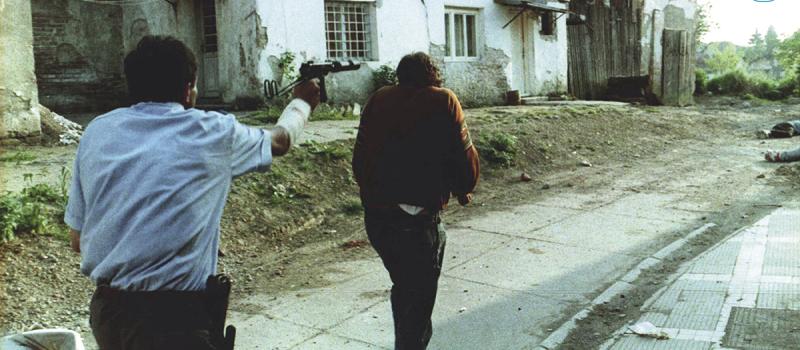
Killing for the Photo: Story Behind the Only Photographs of an Execution in the Yugoslav Wars
A reconstruction of the story behind the only professional photographs to capture an execution during the Bosnian War. The images, taken in Brčko in May 1992, show the cold-blooded murder of Bosniak civilians by Serb war criminal Goran Jelisić. Reuters purchased the photograph, which was published worldwide and won a World Press Photo award a year later. It has since raised questions: how could a photographer capture a killing from such close range? Why did the perpetrator allow himself to be photographed? And what role did the photographer himself play in what happened? The investigation reconstructs events on the basis of almost thirty sources from around the world: the photographer and his colleague who were present at the time, Jelisić himself — since sentenced to 40 years in prison by the International Criminal Tribunal for the former Yugoslavia (ICTY) — the victim's family, Reuters editors, members of the World Press Photo jury at the time, war correspondents, and ICTY investigators and witnesses. The investigation exposes a web of complicity and propaganda, and raises pointed questions about journalistic ethics: what role did the camera itself play in the violence, and did editors and jury members ever reckon with that before honouring the photograph?
The other five shortlisted investigations likewise reflect the breadth of cross-border investigative journalism this year: Bad Practice (OCCRP, VG and The Times, on doctors who continue practising unhindered in another EU country after being struck off in one), The Great Firewall Export (InterSecLab and partners, on the global sale of Chinese censorship and surveillance technology), In the Russian Penal Colony, They Called Him 'Dr. Evil' (RFE/RL's Schemes and OCCRP, on the torture of Ukrainian prisoners of war), State Children (Slidstvo.Info, Investigace.cz/OCCRP and a Turkish journalist, on the abuse of evacuated Ukrainian orphans in Turkey), and The Viktoriia Project (Forbidden Stories and a thirteen-outlet consortium, on the disappearance and death of Ukrainian journalist Viktoriia Roshchyna). The full shortlist, with detailed descriptions of all ten projects, is available on the IJ4EU website.
Journalismfund Europe supports cross-border investigative journalism through a range of competitive grant programmes, including the European Cross-Border Grant and Earth Investigations.