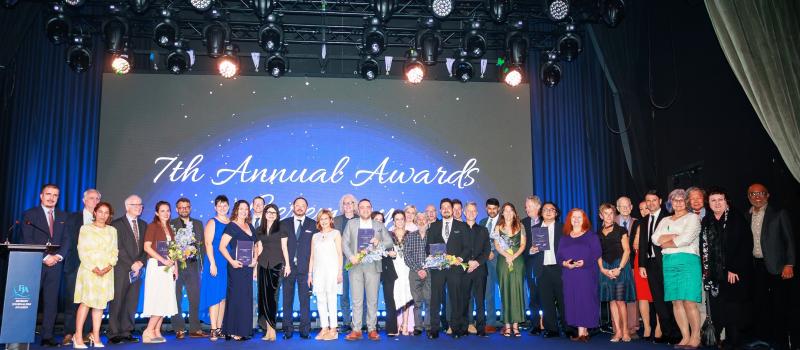
The winners were announced on 3 November 2026. The awards will be presented on 19 November in the Sala Europa of the European Parliament Office in Spain, in Madrid.
Exporting Abortion: first of its kind
Although Exporting Abortion was entered in the Data category, but the jury moved it to the General category. It cited the project's high standard, its thoroughness and detail, its documentation work and its social impact.
This investigation is the first to quantify the number of women in Europe who have to leave their own country to access an abortion. In 2023 alone, this figure stood at 5,860, with over 27,000 women having done so between 2019 and 2023. To arrive at these figures, the team standardised official statistics from ten receiving countries, filed over 100 freedom of information requests, and interviewed numerous women.
The team mapped the main routes for this medical urgency trips, such as from Germany to the Netherlands (more than 1,000 women a year) and from Portugal to Spain (more than 500).
At Público, the work was carried out by Sergio Sangiao, Emilia G. Morales and Ignacio Calle. In total, the team behind this ininvestigation included journalists from ten countries, with partner media including The Journal (Ireland) and OKO.press (Poland).
The project received €11,000 of funding from Journalismfund Europe through its European Cross-border Grants programme.
Green to Grey: visualising illegal construction in protected nature
In the Data category, the jury awarded España (des)protegida: bienvenidos al paraíso del ladrillo ilegal, by Ana Tudela and Antonio Delgado of Datadista. The jury praised their innovative storytelling, the importance of the story for public interest, as well as the quality of the sources and the interactive visualisations.
The publication forms part of Green to Grey, an large-scale investigation in eleven countries. It was initiated by the Norwegian broadcaster NRK, coordinated by Arena for Journalism in Europe and provided with scientific advice by the Norwegian Institute for Nature Research (NINA). Funding was provided by IJ4EU and Journalismfund Europe, with the latter contributing €40,950 through its Environmental Investigative Journalism grant programme.
The consortium of journalists used artificial intelligence to analyse approximately 185,000 satellite images and manually verified over 10,000 locations. The findings revealed that between 2018 and 2023, Europe turned about 9,000 square kilometres of natural habitats and farmland into urban areas, with over 150,000 new constructions overlapping protected areas.
In their piece Datadista looked at why illegal buildings in Spain remain standing despite final court rulings, using three case studies: The first is 185 luxury homes on the island of Valdecañas in Cáceres, which are located within a Natura 2000 site. The second is the El Algarrobico hotel in Cabo de Gata. The third is and more than 15,000 irregular homes in La Axarquía in Málaga.
Datadista is a small collective which this year celebrated 10 years of successful investigative work and for whom this is their third API award. Two previous awards were received in 2023 and 2025, also for the investigations supported by Journalismfund (Under the Surface and The Dark Trace in the Water of Cheap Meat Business).
About the Premios API
The Asociación de Periodistas de Investigación (API) is a Spanish professional association affiliated with FAPE, the Federation of Journalists' Associations of Spain. It promotes investigative journalism as a public service and gives it visibility. Its annual awards recognise the best Spanish investigative work at national, local and data level. This sixth edition added a fourth category, Audiovisual.
A committee of API members preselected twelve finalists from all entries. The jury, chaired by the journalist Esther Poveda, met on 8 October. Its other members were Brenda Chávez (investigative journalist), Alfonso Palazón (professor at Universidad Rey Juan Carlos, director and producer), Laura Martínez (elDiario.es, Valencia edition) and science and data journalist Fermín Grodira.
The ceremony is hosted by the European Parliament Office in Spain and is meant to highlight transnational investigative journalism at European level. It opens with a panel on cross-border investigations, including the European Parliament's Daphne Caruana Galizia Prize for Journalism, which had four Spanish journalists among its finalists this year. API announcement (in Spanish).
The other winners
The first Audiovisual award went to México: ranchos de muerte by Xaquín López and Pelayo Prieto for RTVE's En Portada, on the "extermination ranches" of organised crime in Mexico. The Local award went to infoLibre's investigation into a network of shell companies in Mallorca using fake dating websites for possible money laundering, by Sergio Sangiao and Begoña P. Ramírez. It is the Spanish part of Dirty Payments, coordinated by European Investigative Collaborations (EIC). That makes Sergio Sangiao a winner in two categories this year.
The jury also gave a special mention in the General category to the podcast Se llamaba como yo by Isabel Cadenas Cañón, on the legacy of ETA terrorism.
More info: investigacionapi.com