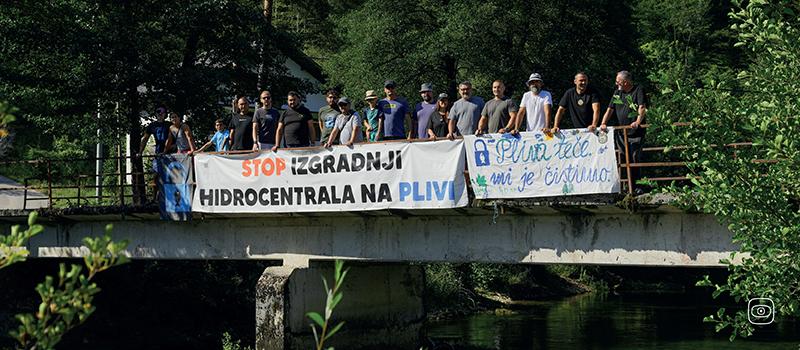
The Battle for the Blue Heart of Europe: Communities Who Refuse to Surrender Their Rivers examines how small hydropower projects continue to advance in Albania and Bosnia and Herzegovina despite community opposition, judicial rulings and commitments to environmental protection.
In Albania, 270 administrative records of hydropower contracts and projects were examined, while 440 preliminary hydropower project groupings were identified through water-management records. An analysis of 127 hydropower-related cases before the Administrative Court of Appeal found that 73 remained pending as of September 2026.
In Kurdari, residents have repeatedly mobilised against the Doma hydropower project, which received a 30-year electricity generation licence in August 2026 despite continuing opposition. In Guri i Bardhë, a contested project resurfaced with a new environmental application, while in Kukës, irrigation shortages triggered farmers’ protests and institutional inspections. In Çidhën, eleven residents secured a favourable appellate ruling against the Seta 4 hydropower project after more than seven years of litigation.
In Bosnia and Herzegovina, three environmental permits for the proposed Jovići hydropower plant on the Pliva River were annulled by courts, while the proposed boundaries of a future protected landscape had been altered to exclude the project site.
Based on official records, court decisions, institutional correspondence, field reporting and scientific assessments, the investigation documents the gap between environmental commitments, administrative decisions and the effective protection of rivers and local livelihoods.
Key findings
- Hundreds of hydropower projects documented in Albania: An analysis of official records identified 270 administrative entries for hydropower contracts and projects and 440 preliminary project groupings in water-management records, including 98 in the Mat River basin. These figures do not necessarily represent individual operating hydropower plants.
- A 30-year licence despite community resistance: In Kurdari, residents have organised repeated protests against the 1.695 MW Doma project, fearing the diversion of water used for irrigation and agriculture. Despite ongoing legal opposition, a 30-year electricity generation licence was granted to the developer on 10 August 2026.
- Disputed consultations and irrigation shortages: In Guri i Bardhë, a previously contested hydropower project returned with a new application in July 2026, while a state audit identified irregularities in earlier approval procedures. In Kukës, farmers protested irrigation shortages, prompting an official inspection and a reminder to the concessionaire of its water-supply obligations.
- 127 hydropower-related court cases: In Albania, 127 cases were identified before the Administrative Court of Appeal, including 73 pending proceedings. At least 20 cases involved community-related disputes across seven conflicts. In the Seta 4 case, eleven residents obtained a favourable appellate ruling after more than seven years of litigation, although further proceedings remained unresolved
- Hydropower inside protected areas and substantial economic interests: In Albania, Seta 1+2 and Seta 3 were confirmed to be located within Lurë–Mali i Dejës National Park. Corporate records showed that their concessionaire, HYDRO SETA, reported approximately €2.47 million in pre-tax profit in 2024.
- Three environmental permits annulled in Bosnia and Herzegovina: In the Pliva River case, three environmental permits for the proposed 0.6 MW Jovići hydropower plant were annulled. In December 2023, the proposed boundaries of a protected landscape were altered by Republika Srpska authorities, excluding the project site. The administrative and judicial dispute remains unresolved.
- Limited electricity contribution and increasing environmental pressure: In Bosnia and Herzegovina, 126 small hydropower plants generated 350.79 GWh in 2025, accounting for just 2.41% of national electricity production. Across the Balkans, scientific assessments documented the loss of approximately 2,450 kilometres of near-natural river stretches between 2012 and 2025
Methodology
The cross-border investigation combines freedom-of-information requests, institutional responses, concession agreements, environmental permits, inspection reports, court decisions, official energy statistics and field reporting.
In Albania, records covering hydropower development, licensing, water management, environmental protection and judicial proceedings were obtained from public institutions. Administrative datasets were analysed and cross-checked todistinguish concession contracts, project groupings and individual hydropower facilities. Judicial records were examined to assess the status and duration of disputes, while corporate ownership and financial information was reviewed for selected projects.
In Bosnia and Herzegovina, concession documents, environmental permits, court rulings and institutional correspondence were examined, alongside official electricity production data and changes to proposed protected-area boundaries.
In both countries, field visits and interviews with affected residents, environmental specialists, scientists and other stakeholders complemented the documentary findings. Scientific assessments were used to place individual cases within the wider context of river degradation across the Western Balkans.
Data
The investigation draws on newly obtained institutional data, administrative registers, judicial records, environmental and construction permits, corporate information, inspection findings and official energy statistics.
In Albania, 270 hydropower-related administrative records and 440 preliminary project groupings were examined, alongside 127 appellate court cases. Of these judicial cases, 73 remained pending and at least 20 concerned community-related disputes. Additional findings covered environmental licensing, protected areas, company ownership and financial performance.
In Bosnia and Herzegovina, official data from the State Electricity Regulatory Commission (DERK) showed that 126 small hydropower plants generated 350.79 GWh in 2025, equivalent to 2.41% of national electricity production. Judicial and administrative records also documented three annulled environmental permits concerning the Jovići project.
Regional scientific context was provided by The State of Balkan Rivers 2025, which documented the deterioration of near-natural river systems across the Balkans.