Every time we get ready for the summer barbecue season, we forget to look beyond the flames and examine the charcoal itself, revealing a supply chain that is far less transparent than the product suggests. The investigation does just that. Across five European countries, the team identified procurement links connected to a Ukrainian charcoal producer currently under investigation for alleged illegal production practices.
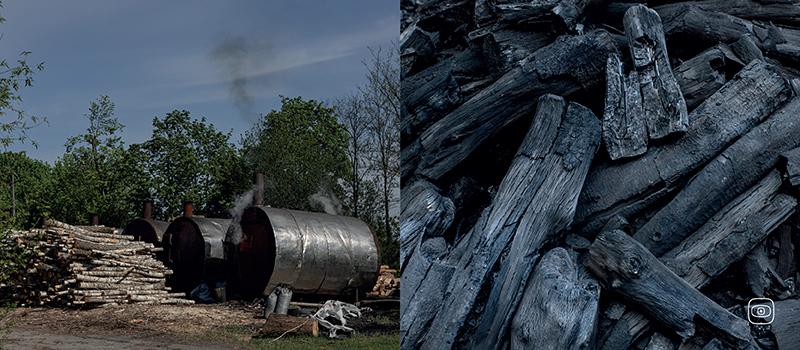
In the Ukrainian village of Vyhiv, an unpermitted pyrolysis kiln operates on agricultural land where a worker shovels charcoal without gloves or a mask. This charcoal ends up on barbecues in France, Poland, Romania, Belgium, or the Netherlands. In autumn 2025, a search at SRL Carbon Pro in Vyhiv led to the seizure of charcoal pallets labeled "Charbon de Bois", unlabeled pallets, and metallic production tanks. Accusations indicate illegal production on agricultural land, supported by state forestry officials understating wood volumes and covering sales without a license.
Customs data shows this charcoal goes to European clients like Grill Impex Polska, Maras Sommer, Flamaco, Beyond Barbecue, and La Forestière du Nord, which sells it under the French brand "Grill O'Bois". Similar investigations exist in Makariv (unauthorized emissions and FSC labels linked to Belgian supply chains) and Shybene (soil contamination exceeding limits for boron, manganese, and arsenic).
An industry source reveals the core scheme: manipulating the "consumption coefficient" (wood-to-charcoal ratio) or buying documents for unused timber to make illegal wood look legal. According to estimates, in the first eight months of 2025, about 10,000 tonnes of Ukrainian charcoal were sold in Europe, with only 1,500 to 3,000 tonnes coming from legal production.
The result is a dual system: a price-driven global chain hampered by delayed EUDR regulation, operating alongside sustainable European projects, like France's Soler Group, struggling against cheap, unverified imports.
Main Findings
- Document Laundering in Ukraine: Operators manipulate "consumption coefficients" or buy fake documents for unused timber to make illegal wood appear legal. Out of approximately 10,000 tonnes of Ukrainian charcoal sold in Europe in the first eight months of 2025, only 1,500 to 3,000 tonnes came from legal production.
- Direct Supply Links to EU Retailers: Customs data connects Ukrainian producers under investigation to European buyers in Poland, Germany, Belgium, the Netherlands, and France (repackaged under domestic brands like "Grill O'Bois").
- Pollution & Health Hazards: Unlicensed production causes soil contamination with heavy metals (boron, manganese, arsenic) and uses unequipped workers operating without gloves or masks on agricultural land lacking permits.
- Economic Strain on Clean Producers: Due to unenforced EUDR rules, legal European producers using clean technology (such as Soler Group) face rising local costs and cannot compete against cheap imports brought through intermediaries.
Methodology
- On-the-Ground Site Visits: Field reporting at unlicensed pyrolysis production sites in Ukrainian villages (Vyhiv, Makariv, Shybene).
- Customs & Criminal Records:Analysis of customs export data, police search seizures, and judicial investigation filings.
- Industry Witnesses & Corporate Feedback: Testimony from an anonymous industry insider detailing laundering schemes, alongside business responses (Maras Sommer detailing €300,000 in losses and Soler Group).
- Expert & Industry Analysis: Integrating market insights from Earthworm Foundation (Lukas Feiler) regarding certification flaws and EUDR regulatory delays.