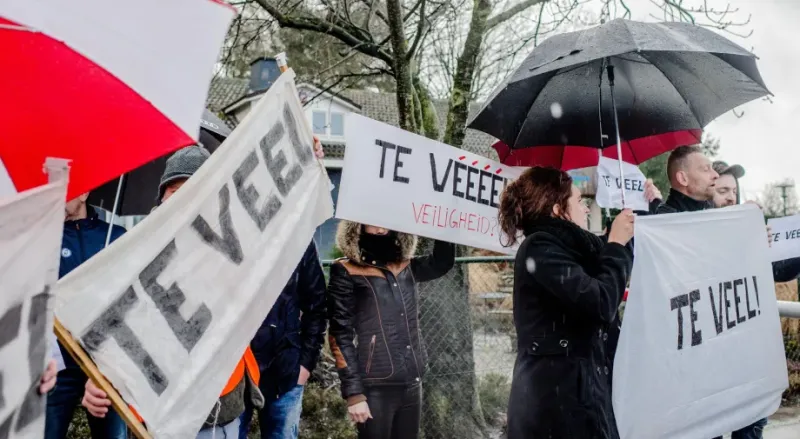
As soon as a new location is announced, the party’s MPs react in parliament and on social media. Within a few days, a protest follows, attended by party leaders, accompanied by leaflets, petitions and demonstrators from outside the municipality. In Jabbeke, according to Mayor Frank Casteleyn (CD&V), only about ten of the fifty or so protesters were local residents. The same was true in Schilde: there were few local people at the protest.
This protest is also having an impact on local councils. In at least eighteen municipalities, the council opposed the centre either publicly or through official channels, and in at least twelve municipalities, mayors themselves took the matter to court. Such legal proceedings rarely prevent a centre from opening, but they do cause delays, reduced capacity or early closure. This is happening under mayors from almost all political parties.
Experts point to the consequences: an inefficient stop-and-go policy and a distorted picture of a society that is supposedly overwhelmingly opposed to asylum seekers. According to sociologist Dirk Geldof, public support has been “deliberately undermined”. Minister for Asylum and Migration Anneleen Van Bossuyt (N-VA) cites precisely this lack of public support to justify her policy, under which she aims to reduce reception capacity from 34,000 to 12,000 places.
In hindsight, the fears in most municipalities have proved unfounded. In Jabbeke, the problems were limited to a bit of noise and litter, and Casteleyn now regrets having allowed himself to be whipped up into a frenzy. In Schilde, 178 asylum seekers live in peace; local residents’ reactions are largely positive and, according to a local councillor, crime figures in the neighbourhood have even fallen. The same sentiment was expressed in the other municipalities visited: the fears were unfounded. A 2021 survey by Fedasil confirms this picture: three-quarters of the 62 mayors surveyed felt that the reception centre was well integrated into their municipality.