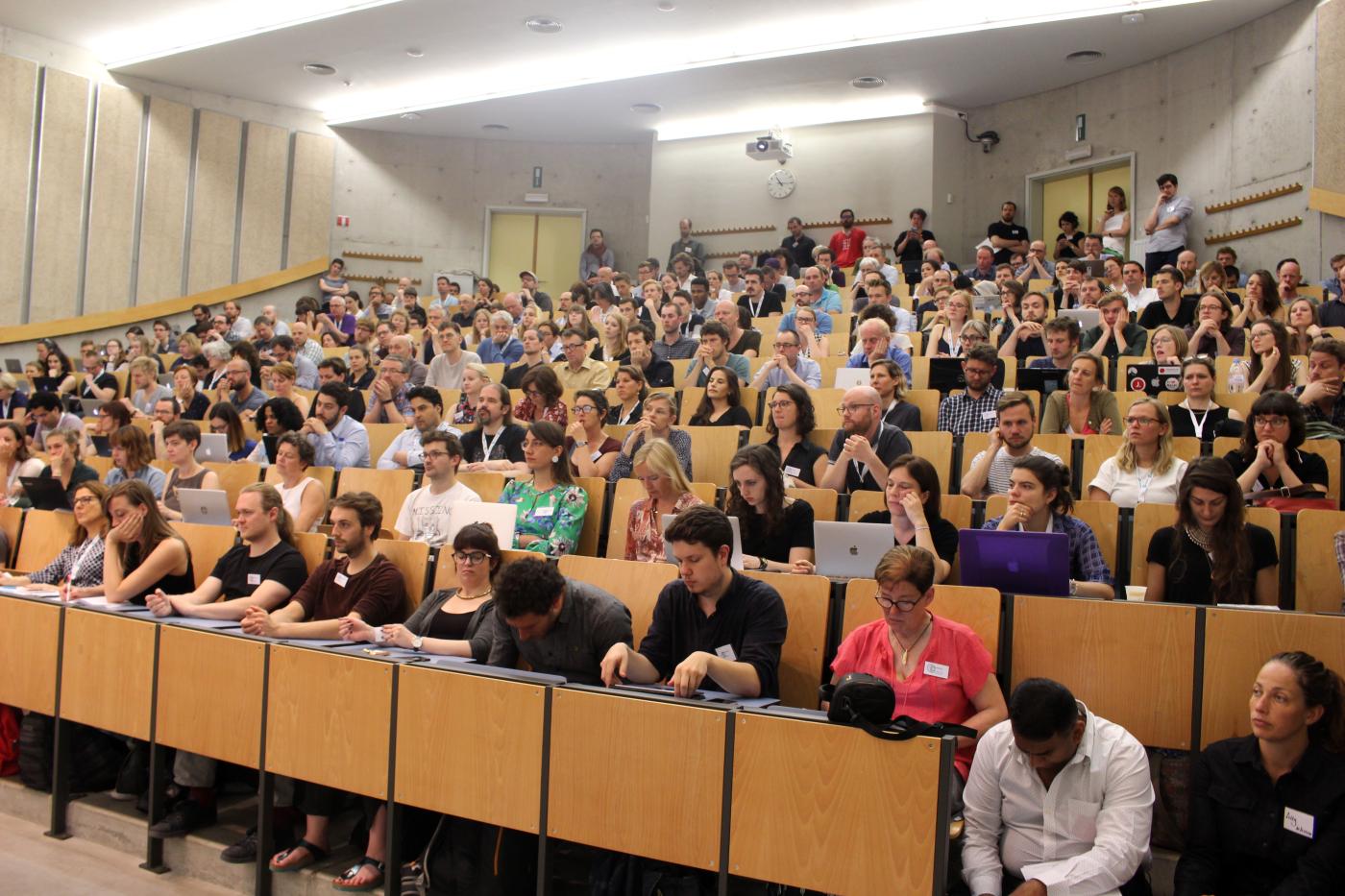
Formally founded in 2011, the EIJC & Dataharvest merged three networks: journalists, coders and FOI-specialists. This event was organised by Journalismfund Europe, Wobbing.eu and Farmsubsidy.org to create an opportunity to learn from each other, share and develop best practices, make contacts and develop stories together.
The roots, however, run deeper. To understand the conference, one has to start with Farmsubsidy.org.
The origins in Farmsubsidy.org
In 2004, Danish journalists Nils Mulvad and Kjeld Hansen obtained data on all Danish recipients of EU agricultural subsidies. The following year, British journalist Jack Thurston succeeded in obtaining the same for the UK. Together they founded Farmsubsidy.org with the aim of getting agricultural subsidy data released across all EU member states through collaboration between journalists and organisations in each country. Danish journalist Brigitte Alfter joined shortly after to coordinate the work in other countries.
Farmsubsidy was not a purely journalistic network. It was a coalition of different actors held together by a shared aim: to get data released and published. The network included individual journalists, media outlets, a scientific institute in France, non-profit organisations in the Netherlands and DICAR in Denmark. The idea was simple. Pool the effort of getting the data out into the open, publish it, and let each participant build their own stories and analyses on top.
The EU Social Fund financed the central work up to the end of 2006 through DICAR. The Open Society Foundation paid for the first Farmsubsidy conference in Budapest in 2007. From then on, the Hewlett Foundation funded the work for several years. During this period, the network met once a year, first in London and later in Brussels, to extract, clean and process data from the EU member states. The gatherings brought together journalists, activists and IT people.
Along the way came recognition. In 2006, Nils Mulvad was named European Journalist of the Year by European Voice, owned by the Economist Group, for the work on getting agricultural subsidy data published across Europe. At the IRE conference in June 2007, Jack Thurston, Brigitte Alfter and Nils Mulvad received the IRE Freedom of Information Award for the breakthrough in transparency around agricultural subsidies, which at that time made up about half of the EU's total budget.
When the Hewlett Foundation ended its support, Farmsubsidy.org moved under the wings of the Pascal Decroos Fund, later Journalismfund Europe. Journalismfund's own account of the transition is here.
Dataharvest becomes a European conference
The May 2012 gathering was the first held under the wings of Journalismfund. The idea of bringing journalists, activists, coders and others together around obtaining, structuring, analysing and publishing data continued, but the scope broadened quickly. The event was no longer only about agricultural subsidies. It became a meeting place for all forms of investigative journalism.
A parallel network, Wobbing.eu, had emerged from a January 2007 gathering of journalists specialised in freedom of information legislation. They worked on shared considerations such as access to data, obstacles in access to information and privacy.
From the last get-together under the support of Hewlett Foundation in May 2011 in Brussels, 35 founding participants laid the ground for the future of the conference, adopting the name of the Farmsubsidy.org network's own gatherings: Dataharvest. Since then, the conference has gradually grown in focus and size. It went beyond farm subsidy data and FOI legislation, offering lectures and workshops on online and database searching, data analysis and data visualisation. FOI experts were invited to share their experience and best practices. Brainstorms were organised to generate new story ideas. Coders and data journalists exchanged methods. Cross-border investigative stories were shared.
By 2015, the features of a genuine European Investigative Journalism Conference were clear, with a strong focus on all aspects of data journalism, networked collaborative journalism and entrepreneurial journalism.
And the approach of the conference worked: several stories, projects and networks in Europe have come to life at one of these editions of the EIJC & Dataharvest and we hope there are many more to come.
The number of participants of the EIJC & Dataharvest increased every year. From 35 founding participants in 2011, over nearly a hundred in 2012, 150 in 2013, 200 in 2014 and 270 in 2015, to 320 for the 2016 edition. The 2017 edition, EIJC/ Dataharvest saw some 382 people from 52 different countries attend. The last Dataharvest organised by Journalismfund Europe (in 2018) counted 470 participants from 52 countries.
----------------------------------------------------------------------
Archive
- Did you miss the Data Harvest Conference? Have a look here, 14/05/2012
- Lessons from the Data Harvest Conference in Europe, 15/05/2012
- #dataharvest13, 04/03/2013
- World Press Freedom Day Event with Nils Mulvad, Rob Wijnberg, a.o., 25/03/2013
- “Data is raw information, devoid of subjective interpretation”, 03/04/2013
- "People are even talking about it through WhatsApp", 15/04/2013
- #dataharvest13 – A Fruitful Produce, 08/05/2013
- "People have all sorts of illusions about investigative journalism which I guess I wanted to tackle", 14/05/2013
- Dataharvest+, The European Investigative and Data Journalism Conference, 15/01/2014
- Joris Luyendijk: “There’s no such thing as a fly on the wall”, 27/01/2014
- OpenInterests.eu: four databases in one, 06/02/2014
- EU agencies to present data catalogue at Dataharvest+, 14/03/2014
- Dataharvest+, 11/04/2014
- EU Ombudsman Emily O’Reilly to speak at Dataharvest+, 16/04/2014
- Dataharvest, Sched, 08/05/2014
- Keynote speech at the Fourth Dataharvest Conference, 09/05/2014
- Luyendijk at #DHplus: "A word cloud of my blog would have featured ‘idiot’ and ‘naive’", 11/05/2014
- #DHplus 2014: the numbers, 14/05/2014
- Joris Luyendijk at #Dhplus: the concept behind the Banking Blog, 15/05/2014
- Joris Luyendijk op #DHplus: het concept achter de Banking Blog, 15/05/2014
- Tyson Evans at #DHplus: design, technology and journalism, 15/05/2014
- ICIJ Deputy Director Speaking at Dataharvest+ 2015, 11/12/2014
- Norwegian journalist who discovered secret surveillance speaking at Dataharvest+, 18/12/2014
- Preliminary Programme Dataharvest EIJC15 online, 26/03/2015
- Dataharvest 2015, Sched, 07/05/2015
- Collaboration Featured as 300 Gather for Dataharvest, 10/05/2015
- The Dataharvest/EIJC 2015 in a Nutshell, 19/05/2015
- Indian FOI expert Shyamlal Yadav at #DHplus, 19/05/2015
- No to “PR coverage for politicians”, 20/05/2015
- “Investigative journalism is not something only reserved for the enlightened”, 20/05/2015
- Dataharvest/EIJC June 2016 : investigative, data, cross-border, financial, surveillance and FOI journalism, 30/03/2016
- #PanamaPapers at the 2016 Dataharvest Conference, 04/04/2016
- Dataharvest 2016, Sched, 02/06/2016
- The end of Gollum journalism – Mar Cabra’s keynote at #EIJC16, 08/06/2016
- Flemish minister of Media Sven Gatz' speech at the #EIJC16 reception, 10/06/2016
- A Data Desk Is Not An Island — The Data Track at #EIJC16, 24/06/2016
- Edouard Perrin centrale spreker op Dataharvest '17, 10/02/2017
- Edouard Perrin Keynote Speaker Dataharvest '17, 10/02/2017
- Keynote: Algorithmic Accountability Reporting, 05/04/2017
- Dataharvest, Sched, 18/05/2017
- An introduction to covering finance by Nick Mathiason #EIJC17, 21/05/2017
- Self-defence for journalists in the digital age - #EIJC17, 23/05/2017
- Dates announced for EIJC18 and EIJC19, 31/05/2017
- CFP: Algorithmic accountability reporting, 01/03/2018
- Fact checking: Get it right every time!, 09/03/2018
- Dataharvest 2018, Sched, 23/05/2018
- Joris Luyendijk’s keynote speech at EIJC18, 28/05/2018
- Press Release: EIJC & Dataharvest Conference to become an independent organisation, 18/09/2018