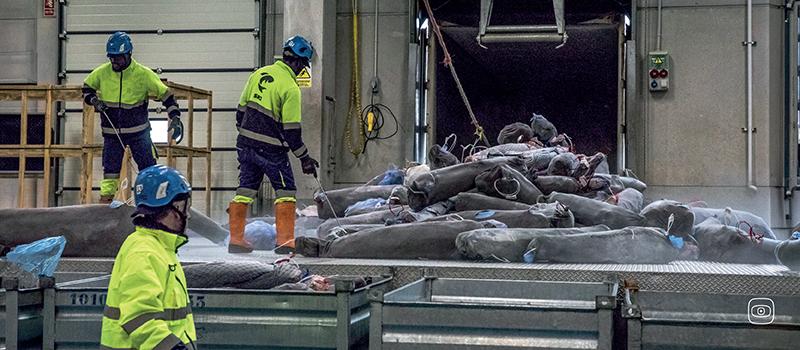
This investigation follows the blue shark from longline fleets in the Atlantic and Pacific Oceans to processing facilities in Galicia and the shark-fin trade in Taiwan. The investigation reveals a supply chain in which almost every part of the animal is sold on: the meat is sold across Europe and beyond, while the fins are traded in Asia, despite falling demand in some traditional markets.
At the heart of the investigation lies the industry’s claim that blue shark fishing is sustainable. In many parts of the world, thies species is still caught without an overall catch limit. In the North Atlantic, where quotas do exist, the latest assessment puts the probability of the stock already being overfished at 50.1 per cent, essentially a coin toss. The investigation shows how scientific uncertainty, inadequate data and political negotiations permit millions of blue sharks to continue to be part of a lucrative global trade.
Key findings
- Spain and Taiwan dominate the global blue shark catch, accounting for 64.5 % of reported landings in 2024 (FAO): Spain 45,400 tonnes, Taiwan 31,900 tonnes. This was Taiwan’s highest North Pacific catch since 2009.
- Official figures understate the fishery. In 2019, Sea Around Us estimated the global catch at around 347,000 tonnes, which is more than three times the 110,000 tonnes reported to the FAO.
- It is the fins that makes the business profitable. According to a major Vigo processor, neither swordfish nor blue shark would be profitable on their own.
- Claims of sustainability rest on uncertain science. There is a 50.1% probability that the North Atlantic stock is already overfished. In the South Atlantic, there is a 54 % probability of overfishing occurring. The Indian and Pacific Oceans have no overall catch limits.
- At its April 2026 meeting, ICCAT failed to agree on objectives for new harvest rules. These are not expected before 2029.
- The fin trade persists. In Taiwan, for example, fins retain their value even though as younger consumers are turning away from them. Singapore, Hong Kong and China remain major destinations for EU fin exports.
Methodology
- Analysis of FAO FishStat and Sea Around Us catch data sets, stock assessments and meeting records of the regional fisheries management organisations, as well as trade data from DataComex and UN Comtrade.
- Field reporting in Vigo in May–June 2026 at fish markets, producer organisations and supermarkets, and inside a major processing company, from unloading to fin removal and meat processing.
- Field reporting in Taiwan at several fishing ports, wholesale and consumer markets and fin retailers.
- Interviews with industry representatives, processors, traders, scientists, conservationists and observers at regional fisheries bodies.
- Right of reply sent to the fisheries authorities of South Africa, Taiwan, Japan and the United States, and to ICCAT.