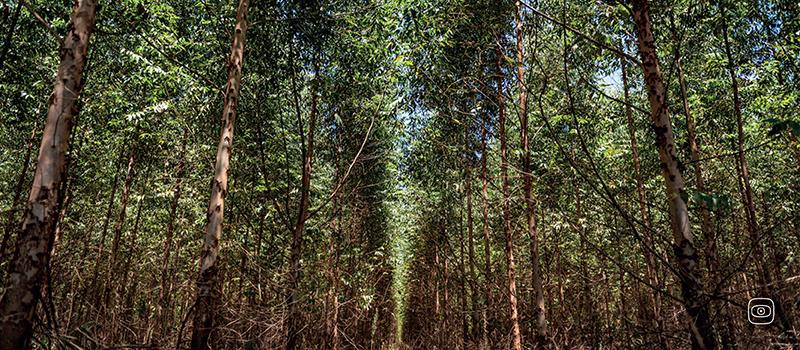
Backed by Grupo Zapag, a Paraguayan conglomerate with interests spanning fuel distribution, energy, agribusiness and infrastructure, alongside Austrian pulp producer Heinzel Group and Swedish forestry investor Girindus Investments, Paracel has been billed as the largest private investment in Paraguay’s history. The company plans to invest around US$5 billion in an industrial complex that would turn timber from more than 100,000 hectares of plantations, an area larger than New York City, into 1.8 million tonnes of bleached eucalyptus pulp each year.
Paracel says the project will create thousands of badly needed jobs in one of Paraguay’s most remote and impoverished regions. It also claims it will help protect existing ecosystems while reforesting former cattle ranches with around 160 million non-native eucalyptus trees, which the company says will capture carbon and help curb global heating.
The European Union has recognised the initiative as a “world-class sustainable cellulose and forestry project”, under its 2025 Global Gateway strategy, the framework guiding the bloc’s international investment and cooperation efforts, and is giving the project support through a €22 million investment intended to fund education and social-protection programmes in Concepción and the neighbouring departments of Amambay and San Pedro.
Key Findings
- Residents of twelve communities within and around Paracel’s area of operations raised serious concerns about the plantations and the planned mill’s current and future effects on water supplies, biodiversity, human health and the climate. Several of these communities said they had not been meaningfully consulted, and faced government pressure to agree to the project.
- Official documents show that Paracel’s plantations are treated with sulfluramid, an insecticide applied in granular bait to kill leaf-cutter ants. Sulfluramid is banned in the EU and breaks down into PFOS, a highly persistent “forever chemical” associated with serious health risks, including cancer. The documents also show that Paracel used glyphosate during the early development of its plantations, a plant-killer the World Health Organization classifies as “probably carcinogenic to humans”.
- Experts warned that even state-of-the-art pulp mills can release harmful pollutants when treatment systems fail, or environmental oversight is weak. In neighbouring Uruguay, where large pulp mills have operated since 2007, companies in the sector have “systematically” breached environmental regulations, according to a researcher at the Universidad de la República in Montevideo.
- Despite its close links to lawmakers involved in drafting Paraguay’s carbon-market legislation, Paracel has yet to obtain the international certification required to sell carbon credits after a rejection related to the additionality of its plantations as a climate solution. Once fully operational, the project’s own figures say it will be a net greenhouse-gas emitter, generating more than 400,000 tonnes of emissions annually - roughly equivalent to the emissions produced by burning 200,000 tonnes of coal.
- Paracel has publicly committed to “zero deforestation” legislation covering the eastern region of Paraguay where it operates. But official documents obtained by this investigation show large-scale deforestation took place, and eucalyptus was planted, on land now owned by Paracel property shortly before it was purchased. Paraguay’s environment ministry found the company not liable for ongoing deforestation but ordered it to take corrective measures.
Methodology
The reporters used FOI requests and land-registry data to piece together evidence that Paracel used highly hazardous pesticides on plantations close to Indigenous communities, and that large-scale deforestation and eucalyptus planting took place on properties shortly before the company purchased them.