A data centre is a large group of networked computers that are typically used by organisations for the remote storage, processing, or distribution of vast amounts of data. They are energy guzzlers: in 2022, the 1,240 data centres in the European Union consumed almost 100 TWh, which equalled 4% of the continent’s power demand. According to think tank Ember, this demand is expected to increase from 96 TWh in 2024 to 168 TWh by 2030 and 236 TWh by 2035 — a rise of almost 150% over the next decade. In Italy, requests to connect to the high-voltage energy grid exceeded 55 GW, accounting for around 40% of the country's total electrical output. Concern over the sustainability of local grids is growing.
However, our investigation reveals that this exponential growth poses a threat not only to European grids, but also to the land market, where land prices are skyrocketing in the Milan area due to speculation.
In 2023, the European Commission introduced a directive requiring all data centres with a power capacity above 500 kW to disclose their energy consumption. However, civil society organisations have criticised the secrecy surrounding such data, which makes it difficult to measure the industry's impact. They highlight the significant additional energy demands at a time when the continent must decarbonise its power grids as quickly as possible to fulfil key climate commitments.
Public authorities urgently need to draft comprehensive regulations for the sector. Germany is one of the countries that has enacted the most advanced regulations. In Frankfurt, grid connection slots have become scarce. Due to their purchasing power with regard to land use, data centre operators have already driven other businesses out of the city. To curb this trend, the Frankfurt city government has recently begun to allow the construction of new data centres only on specially designated plots of land.
Impact
After publishing the investigation on data centres, the information continues to circulate and the Italian journalists have been solicited on numerous occasions to speak about the subject, mainly across Lombardy and Piedmont.
Anna Toniolo presented the investigation at the counter-festival “Italian Tech Resistance,” held in Turin from 1 to 3 October 2025. The initiative was promoted by activists, trade unions, and digital collectives, with the aim of offering a critical perspective on the impact of Big Tech, in response to Italian Tech Week, which hosted figures such as Jeff Bezos. In May, she was invited by a group of students from College Einaudi in Turin to do a workshop on data centres and their connection to the climate crisis. Toniolo was also interviewed by two university professors conducting research on data centres in Italy: in particular, a professor from the University of Turin and an associate professor from the University of Manchester.
In May, Michele Bertelli moderated a public discussion hosted by the local committee opposing the construction of a new Datacentre in Lacchiarella, near Milan.
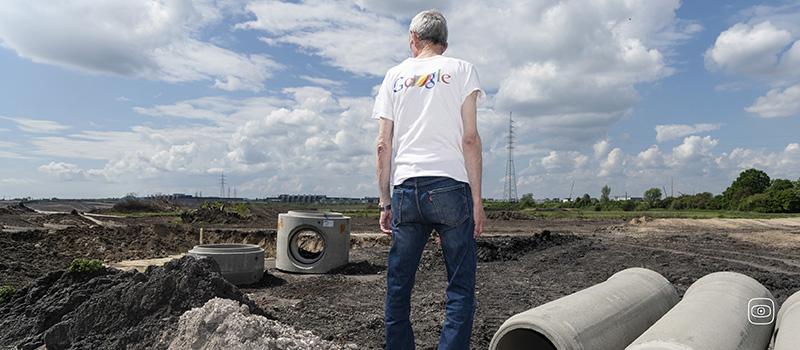
Image: Studio Figure, Cornaredo (Milan) 2025