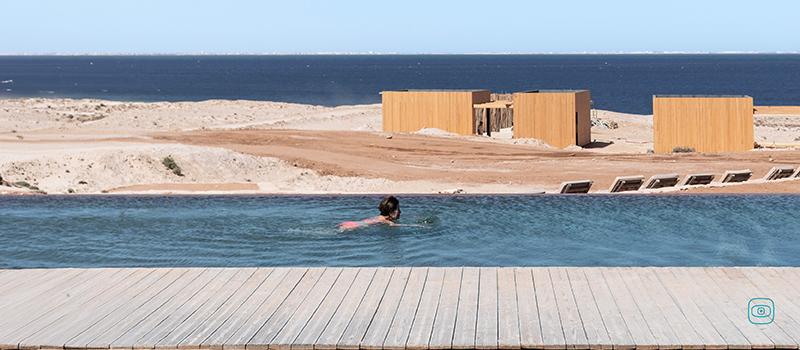
Dakhla, in Western Sahara, is undergoing a major transformation driven by tourism, infrastructure development and investment in renewable energy and agriculture. Promoted by Morocco as an emerging destination for international tourism and water sports, the city is also at the centre of wider development plans involving a new Atlantic port, desalination facilities and expanding urban infrastructure. This investigation examines how these projects are reshaping the territory, who benefits from the investments, and what their implications are for the Sahrawi population. It focuses on the role of foreign companies, tourism operators and international connectivity in the development of a territory whose political status remains unresolved and whose people have not exercised their right to self-determination. Combining field reporting, corporate research and satellite imagery analysis, the investigation traces changes in Dakhla’s urban landscape and examines the connections between tourism, infrastructure and Morocco’s economic strategy in Western Sahara. It also investigates the environmental implications of development in a fragile coastal ecosystem, including the growing demand for water and the expansion of tourism and agricultural activities.
Key findings
- European interests in tourism and real estate: The investigation identified European companies and investors involved in real estate development and construction in Dakhla, as well as French and other European ownership interests in tourism resorts. It also traced links between some tourism developments and Morocco’s royal family, raising questions about who benefits from investment in a territory whose political status remains unresolved.
- A new residential area expanding after years of inactivity: Satellite imagery shows that a road network laid out north of Dakhla airport in the early 2010s remained largely undeveloped until 2023. Construction has since accelerated, particularly towards the Atlantic coast, with villas featuring building footprints of approximately 200–600 square metres. The area covers an estimated 130 hectares, including around 100 hectares of potentially buildable land. Existing building footprints are estimated at no more than 20,000 square metres, suggesting substantial room for further expansion. The pattern of development appears consistent with a low-density, potentially exclusive residential neighbourhood, although its intended market and ownership structures require further investigation.
- Large-scale water infrastructure alongside wind energy developments: Satellite analysis indicates that construction of a desalination facility on the coast approximately 120 kilometres north of Dakhla began in 2023–2024. The site extends for more than one kilometre and includes two large water-storage reservoirs nearing completion. Based on their dimensions in satellite imagery, each reservoir is estimated to hold approximately 170,000 cubic metres of water - equivalent to around 70 Olympic-sized swimming pools. The facility is located in an area that also hosts several wind farms, highlighting the scale of infrastructure development in the territory.
- Development and the future of Western Sahara: Taken together, the expansion of tourism, real estate and water and energy infrastructure raises questions about the economic and environmental consequences of Morocco’s development strategy, the role of foreign investors, and the implications for Sahrawi rights and self-determination.
Methodology
The investigation combines field reporting in Dakhla with documentary research and geospatial analysis. The reporting team conducts interviews with researchers, civil society representatives, local sources and relevant economic actors. Corporate and financial research is used to investigate the ownership structures, investors and business interests behind selected tourism and infrastructure projects. Satellite imagery is analysed to identify and compare changes in urban development, resort construction and infrastructure over approximately ten years. These findings are cross-checked against publicly available records, company information, official statistics and other documentary sources. The investigation also examines the legal and political context of Western Sahara, including the territory’s disputed status and the principle of Sahrawi self-determination.