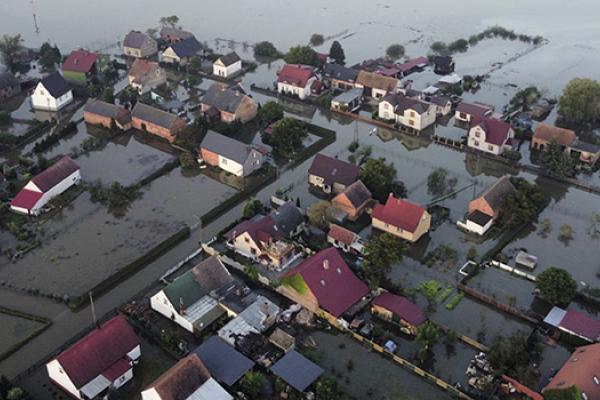
When Azucena Brisa received the emergency alert on her mobile phone on the afternoon of 29 October 2024, the water had already begun to flood Picanya, a town in the province of Valencia. At around half past six, she had seen that the ravine was about to burst its banks and called her parents to tell them to leave the house. That was the last time she spoke to them. By the time the alert sounded, she recalls, it was already too late.
On the night of 19 October 2024, Anzola dell’Emilia, in the province of Bologna, was flooded after the River Cavanella burst its banks. Rosario Miletta was on the ground floor, desperately trying to save her home as the water rose rapidly around her. All the electrical wiring was downstairs. Her daughter called her and told her to go upstairs. She did, narrowly escaping. The first warning message arrived at 1am in the morning, when water and mud were already pouring through the bathroom and sinks and flooding the house. Today, Rosario keeps her home sealed off, with all the windows covered.
Both stories encapsulate one of the central questions of this investigation: what happens when information about a flood reaches people too late — or fails to reach them at all? In both places, the floods have left a lasting mark.
The investigation compares two regions with different emergency systems, both operating within a European framework that requires public warning systems and has channelled public funding into their development. Directive (EU) 2018/1972 requires Member States to have public warning systems capable of reaching people through mobile services, although their implementation and management depend on each country and its authorities. It follows the path of information from forecasts and hydrological data to the moment it becomes — or fails to become — a warning to the public.
Key Findings
Spain
- ES-Alert was fully operational in the Valencian Community on 29 October 2024. Spain’s Civil Protection authorities state that there were no known technical, operational or administrative limitations affecting its use.
- Our reconstruction shows that Spain’s national weather agency, AEMET, and the Júcar River Basin Authority issued weather and hydrological warnings throughout the day and in the days before the floods, well before the mass alert was sent to the public.
- The decision to send an ES-Alert message lay with the Generalitat Valenciana. According to Civil Protection, each autonomous community decides when to send a message, what it should contain and which geographical area it should cover, based on the information available.
- The alert to mobile phones was sent at 20:11, when numerous municipalities were already affected by flooding.
- Part of this chain of decision-making is now under judicial scrutiny. The management of the 29 October emergency, including the decisions taken before the ES-Alert message was sent, forms part of an ongoing judicial investigation, meaning that individual responsibilities have not yet been fully established.
- ES-Alert was developed with European funding through the Next Generation EU programme.
Italy
- In Italy, the IT-alert service has been operational since 13 February 2024, but only for specific civil-protection risks: nuclear accidents or radiological emergencies, major industrial accidents, the collapse of a large dam, and volcanic activity in the Campi Flegrei, Vesuvius and Vulcano Island areas.
- Italy does not currently have a nationwide public early-warning system for floods. The National Department of Civil Protection is carrying out an experimental phase, which is expected to be completed within a year.
- Some Italian municipalities pay private companies thousands of euros to provide flood-warning services to local residents.
- Italy’s National Civil Protection Service operates according to the principle of subsidiarity at national, regional and local level. Mayors act as local civil-protection authorities.
- Following the 2023 and 2024 floods in Emilia-Romagna, many residents reported that warnings reached them too late.
- Regarding the September 2024 flood that affected Traversara and Boncellino, in the province of Ravenna, prosecutors have requested that ten people be sent to trial, including managers and public officials holding positions of responsibility within the regional Civil Protection system.
Methodology
The investigation combines official documentation, chronological reconstruction and field reporting. At European level, we analysed the relevant regulatory framework and contacted key institutions, beginning with the European Commission and the departments responsible for early-warning systems.
In Spain, we cross-checked warnings and records from AEMET and the Júcar River Basin Authority against the Generalitat’s emergency documentation that we were able to access. We also requested additional information directly from the regional administration, but no further documentation was provided.
In Italy, we interviewed the main institutions involved, from the National Department of Civil Protection to local administrations in Emilia-Romagna. We collected documents related to ongoing judicial investigations, analysed public contracts with private companies, and gathered the views of experts and scientists.
In both countries, this work is complemented by interviews with affected residents, experts and institutional representatives, in order to reconstruct not only what information existed and when, but also how that information was — or was not — communicated to the public.
As part of the Expert-Reviewed Scheme, Prof. Marcel Hürlimann, from UPC-BarcelonaTech, provided external expert input on selected technical aspects of the investigation, including flood risk, early-warning systems and the interpretation of hydrological information. The project also benefited from the support of Miranda Patrucic, Editor in Chief at OCCRP, who acted as project advisor during the development of the investigation.