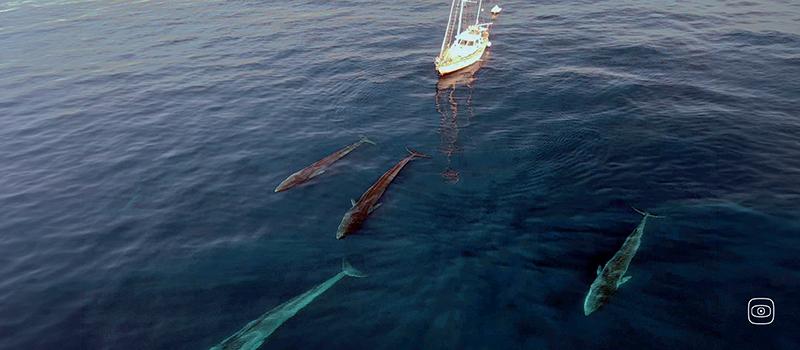
Collisions with ships are a leading anthropogenic killer of the Mediterranean’s two endangered large-bodied cetacean species, sperm and fin whales. Many of their habitats, including the Pelagos Sanctuary, the Spanish Cetacean Migration Corridor, and the Hellenic Trench increasingly overlap with busy commercial routes.
Combining fieldwork with vessel data, whale telemetry data, and interviews with marine biologists, captains, policymakers and shipping policy experts, this investigation showed how dense and fast maritime traffic poses a threat to whale habitats, why critics argue current voluntary speed limits are failing, and the technical and regulatory solutions being tested across different Mediterranean hotspots.
This investigation revealed that major shipping companies continue to travel above recommended speeds in key habitats for endangered whales.
In 2025, thousands of large vessels travelled through the Mediterranean’s key whale habitats at speeds above 15 knots (28 km/h), the threshold above which vessel strikes are considered to be almost always fatal. This included the International Maritime Organization (IMO) designated Particularly Sensitive Sea Area (PSSA) in the North-Western Mediterranean, where vessels are recommended to slow to 10-13 knots.
Key Findings
- Based on Global Fishing Watch Data, almost 2,800 unique vessels travelled above 15 knots - the speed above which strikes are almost always fatal - through the Mediterranean's key whale habitats (Pelagos Sanctuary, Hellenic Trench, Cetacean Corridor) in 2025, with roughly large 30 ships exceeding that threshold at any given moment.
- Speeding remained highly concentrated among a few operators in the PSSA in 2025. Just seven vessels – four Baleária fast ferries and three Grimaldi cruiseferries – were responsible for 70% of the hours spent above 25 knots.
- Seven Grimaldi cruiseferries amounted to around 8% of all hours recorded for all vessels at 15 knots or above in 2025.
- Multiple captains at Grimaldi and Moby said they had not been advised by their companies to slow down when travelling through the PSSA.
Methodology
This investigation combined data-driven methods, fieldwork, and interviews with a variety of experts.
Vessel data in the Mediterranean was provided by Global Fishing Watch (GFW) to identify the number of vessels traversing the Pelagos Sanctuary, the Hellenic Trench, the Cetacean Corridor, and the PSSA at 15 knots or above. These calculations were based on vessels with an IMO number. Habitat boundaries were obtained from the IUCN Marine Mammal Protected Areas Task Force (IMMA), Protected Planet, the World Database on Protected Areas (WDPA), and ACCOBAMS. Designated PSSA marine area boundaries based on the provided IMO coordinates. Commercial manager and beneficial owner data were obtained from Veson Nautical. Gross Tonnage from the highest annual speeders in the PSSA was sourced from VesselFinder. The data was processed in R and QGIS.
Whale telemetry data was provided by the Tethys Research Institute and Edmaktub organisation to animate how whale movements overlap with dense shipping lanes.
The team also joined a Tethys research in the Pelagos Sanctuary and a cetacean monitoring initiative in the Balearic Sea. Dozens of interviews were conducted with marine biologists, conservation scientists, and ocean-policy specialists, as well as with seafaring personnel who are or were active in the PSSA.