Climate and energy in Hungary’s election year!
The project combined two online workshops with a ‘Guide’ and a ‘Dispatch’ on the transition in the country, offering journalists reliable background, expert contacts, and fresh story ideas.
The workshops brought together Hungarian and international reporters to explore the country’s energy landscape – from reliance on nuclear, oil and gas to an impressive growth in battery manufacturing – and the geopolitical pressures shaping its policies, including Chinese investments and Russia’s influence on the Paks nuclear power plant. They provided international journalists with expert insights into Hungary’s domestic climate
and energy developments as well as foreign influence on the country’s energy infrastructure.
A guide – a structured overview of Hungary’s climate and energy landscape – and an election-period dispatch, written by investigative journalist Orsolya Fülöp and published by Clean Energy Wire, are a lasting and publicly accessible resource for journalists covering Hungary’s climate
and energy politics. They remain freely available under Creative Commons licences as long-term resources for journalists across the globe.
By connecting reporters from across borders and equipping them with vetted sources and expertise, the initiative helped raise the quality of public debate on climate and energy at a critical political moment. Journalists interested in similar topics can join CLEW’s free Journalism Network to access resources and connect with peers. A strong example of how structural support for journalists can elevate public debate.
8th April workshop focused on domestic climate and energy developments in Hungary and the role these issues played in the election campaign. Our speakers István Bart, Ada Amon and Orsolya FüLöp discussed Hungary’s climate and energy policy landscape, including the country’s reliance on nuclear energy, its stance on EU climate legislation, and its ambitions to become a global hub for electric vehicle battery
production.
Participants also explored the environmental implications of these developments, such as water usage related to battery manufacturing and Hungary’s involvement in the European lithium supply chain. The workshop helped international journalists better understand the national context behind Hungary’s climate and energy policy decisions and offered numerous story angles for election-related reporting.- 9th April workshop addressed the geopolitical and economic dimensions of Hungary’s energy infrastructure. Discussions focused on the role of Chinese investments in electric vehicle battery production and Russia’s involvement in the expansion of the Paks nuclear power plant. The speakers, Péter Magyari, Eszter Kováts and Vilmos Weiler examined how these investments intersect with EU efforts to reduce strategic dependencies and curb foreign influence
The resulting publications can be found on the CLEW website.
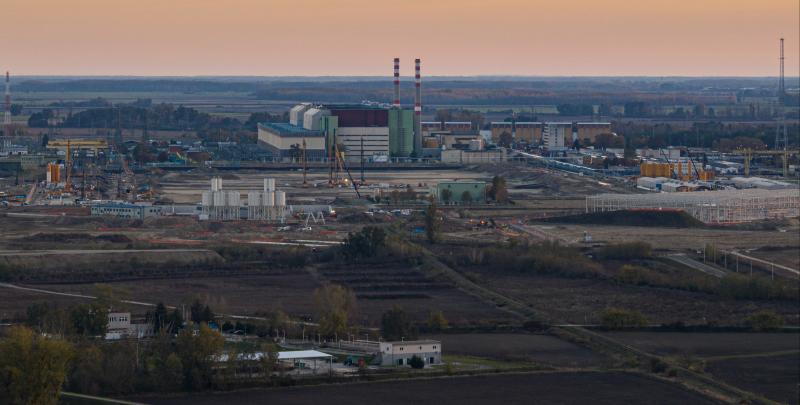
Photo by Paks II. Zrt., A bird's eye view of the construction site of nuclear power plant Paks II on 9 November 2023.